Stonemasonry
Cutting stone in the shop and setting it on the building - the oldest trade on site and still one of the most exacting.
Last updated 2026-09-05
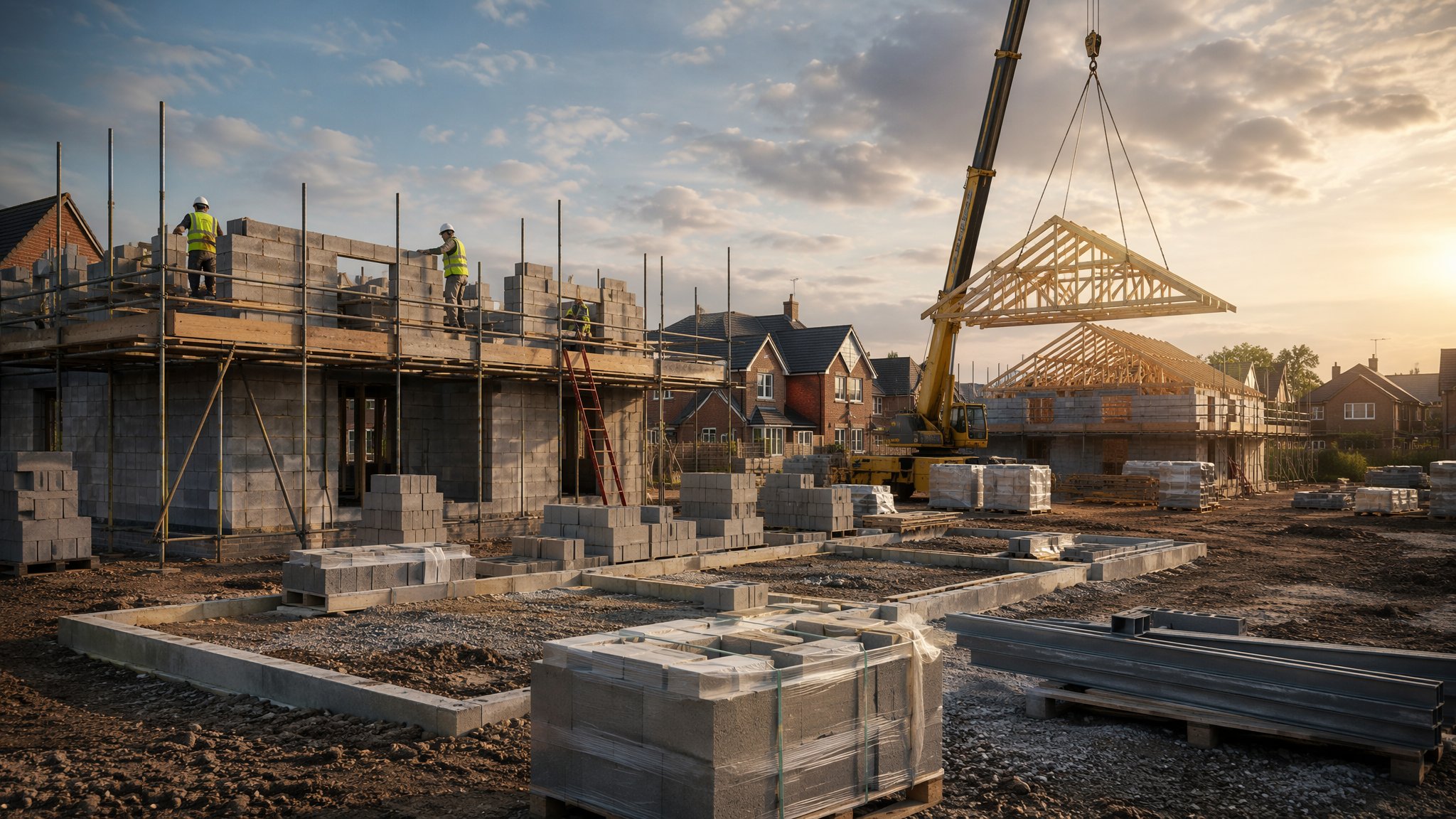
What is Stonemasonry?
Stonemasonry divides into two jobs that are usually done by two different people. The banker mason works at a bench, cutting and dressing stone to templates and drawings - jambs, cills, mullions, copings, string courses, tracery, ashlar blocks. The fixer mason works on the building, setting and bedding those pieces, building rubble walling, and carrying out repairs in place. The two halves need each other and they are costed separately. Most of the money and most of the lead time on a stone project sits in the banker shop and in the quarry, not in the fixing, which is why a stone package is ordered early and why a late change to a window opening is expensive in a way a change to blockwork never is.
The walling itself runs from rubble to ashlar. Rubble walling uses stone roughly as it comes, coursed or uncoursed, squared or random, with wide irregular joints and a good deal of mortar - it is the vernacular of most of the stone regions of the United Kingdom. Ashlar is the opposite: stone sawn and dressed to fine tolerances and laid with very thin joints, so the wall reads as a continuous face of stone. Between the two sit squared rubble, coursed rubble and the various snecked and random-coursed traditions of particular areas. Face finishes range from sawn and rubbed through tooled and punched to a rock face left deliberately rough, and the finish is matched to the surrounding building rather than chosen from a catalogue. On most projects the designer specifies the stone type, the bed height range, the coursing and the finish, and sample panels settle the argument before production starts.
The single technical rule every mason knows is bedding the stone the right way up. Sedimentary stones such as limestone and sandstone were laid down in beds, and they are strongest and weather best when those beds sit horizontal in the wall, the way they lay in the ground. Naturally bedded stone sheds water along the laminations. Stone laid face bedded, with the laminations parallel to the wall face, will delaminate and shell off in sheets as water and frost get between the layers. In cills, copings and projecting courses the mason turns the bed instead, edge bedding it so the laminations run vertically through the depth of the stone and the water runs across rather than into them. The other rule is that repair is done by cutting out and piecing in - a decayed area is cut back to a square recess and an indent of matching stone is let in and bedded, rather than the whole block being replaced or the face being patched over with mortar.
How does Stonemasonry work, step by step?
- 1
Step 1: Select and source the stone
The stone is chosen for appearance, durability and, on repair work, compatibility with what is already there. Matching an existing building means matching geology as far as possible, not just colour, because a stone of different porosity and hardness set next to the original will weather differently and can damage its neighbour. Quarry lead times are long, blocks are reserved, and sample stones are approved before cutting starts. The designer or the conservation officer confirms the match on repair projects. Availability of a particular bed can govern the whole programme, so the stone is usually ordered before the substructure is out of the ground.
- 2
Step 2: Detail, template and cut in the banker shop
Setting-out drawings and templates are produced for every worked piece, numbered to a stone schedule that says where each one goes. Blocks are sawn to size, then worked to the profile by hand or by machine, and the face finish is applied. Mouldings, cills, copings and tracery are cut to the template and checked against it. The stones are marked with their numbers and their bed direction so that the fixer knows which way up each one goes on the scaffold. Careful numbering and stacking in the yard is what stops a lorry-load of expensive worked stone becoming a puzzle.
- 3
Step 3: Set out the walling on site
The fixer mason sets out the courses, the openings and the vertical dimensions against the drawings and the structure as built. Coursing is worked out so that cills, string courses, heads and copings land where they should without a made-up course at the top. On a cavity wall the stone is the outer leaf and is tied back to the inner leaf with wall ties, with cavity trays, weeps and lintels co-ordinated as for any masonry. On solid traditional walling the through stones and the backing are set out at the same time so the wall works as one thickness rather than as two skins that will part company.
- 4
Step 4: Bed and fix the stone
Each stone is set on a full mortar bed, naturally bedded unless the detail calls for edge bedding, levelled, plumbed and lined in to the face. Mortar is specified by the designer to suit the stone, and on soft and historic stone that generally means a lime mortar weaker than the stone itself. Joints are kept to the width the specification allows, which on ashlar is very fine indeed and on rubble is wide and irregular. Large or projecting pieces are lifted mechanically and may be cramped, dowelled or restrained back to the structure in non-ferrous or stainless fixings, since rusting iron cramps are one of the classic causes of split stone in older buildings.
- 5
Step 5: Repair by indent and replacement
On existing buildings the mason works to the principle of doing the least that will last. Decayed stone is cut out to a square, sound recess and a new piece of matching stone is dressed and let in as an indent, bedded in a compatible mortar. Whole blocks are replaced only when the decay goes right through. Mortar repairs are used sparingly, in a mix weaker than the stone, and never as a skin over a face that is still moving. The designer and the conservation officer agree the extent of cutting out before the mason starts, because there is always pressure on site to take out more than is necessary.
- 6
Step 6: Point, clean and protect
Joints are pointed out in the specified mortar and finished to the agreed profile, flush or slightly recessed on most traditional work. Fresh stonework is protected from mortar staining as it is built, because cement and lime splashes on a porous stone are hard to remove and easy to make worse. Cleaning, where required, is done by the gentlest method that works and is trialled on a sample area first, since aggressive abrasive or high-pressure cleaning removes the weathered outer skin of the stone and opens it up to faster decay. Copings, cills and exposed arrises are protected from site traffic until handover.
What are the benefits of Stonemasonry?
- Extremely long service life, with well-detailed stonework lasting centuries
- Repairable in place by indenting, so localised decay does not mean wholesale replacement
- Matches and conserves the character of historic and regional building, which planning often requires
- Very low maintenance once built, with no coatings or applied finishes to renew
- Locally quarried stone carries modest transport carbon and no manufacturing energy beyond cutting
- Works as a rainscreen, a cavity outer leaf, a solid wall or a cladding, so it suits most structural approaches
What are the limitations of Stonemasonry?
- Expensive in both material and labour, with the banker shop and quarry driving cost and lead time
- Long procurement lead times, and late design changes are costly because stone is cut to template
- Skilled masons are scarce, and quality varies more than in most trades
- Heavy - handling, craneage and structural support all have to be designed for
- Face bedding, incompatible mortars and ferrous cramps all cause decay that appears years later
- Weather-sensitive fixing, and lime-bedded work is limited to the milder months
What is Stonemasonry best suited for?
What plant does Stonemasonry need?
- Banker shop with primary saws, profiling machinery, banker benches and hand tools
- Templates, setting-out rods and a numbered stone schedule
- Crane, telehandler, gantry or block-and-tackle for lifting worked stone into position
- Vacuum lifters, lifting clamps, slings and lewis pins rated for the stone weights
- Mortar mill or paddle mixer, pointing irons and hawks
- Scaffold with boarded and protected lifts, plus sheeting for weather and mortar protection
How is Stonemasonry quality-checked?
- Stone samples and sample panels approved for colour, bed height, coursing and face finish before production
- Stone schedule and numbering checked against the setting-out drawings before delivery
- Bed direction confirmed on every worked piece, with natural bedding unless the detail calls for edge bedding
- Mortar mix approved by the designer as weaker and more permeable than the stone
- Fixings, cramps and dowels confirmed as non-ferrous or stainless, with no ferrous metal built in
- Line, level, plumb and joint width checked course by course, and finished faces protected from staining and impact