Deep soil mixing
Bind the weak ground where it lies - mix a binder into it and let the soil become part of the structure.
Last updated 2026-08-25
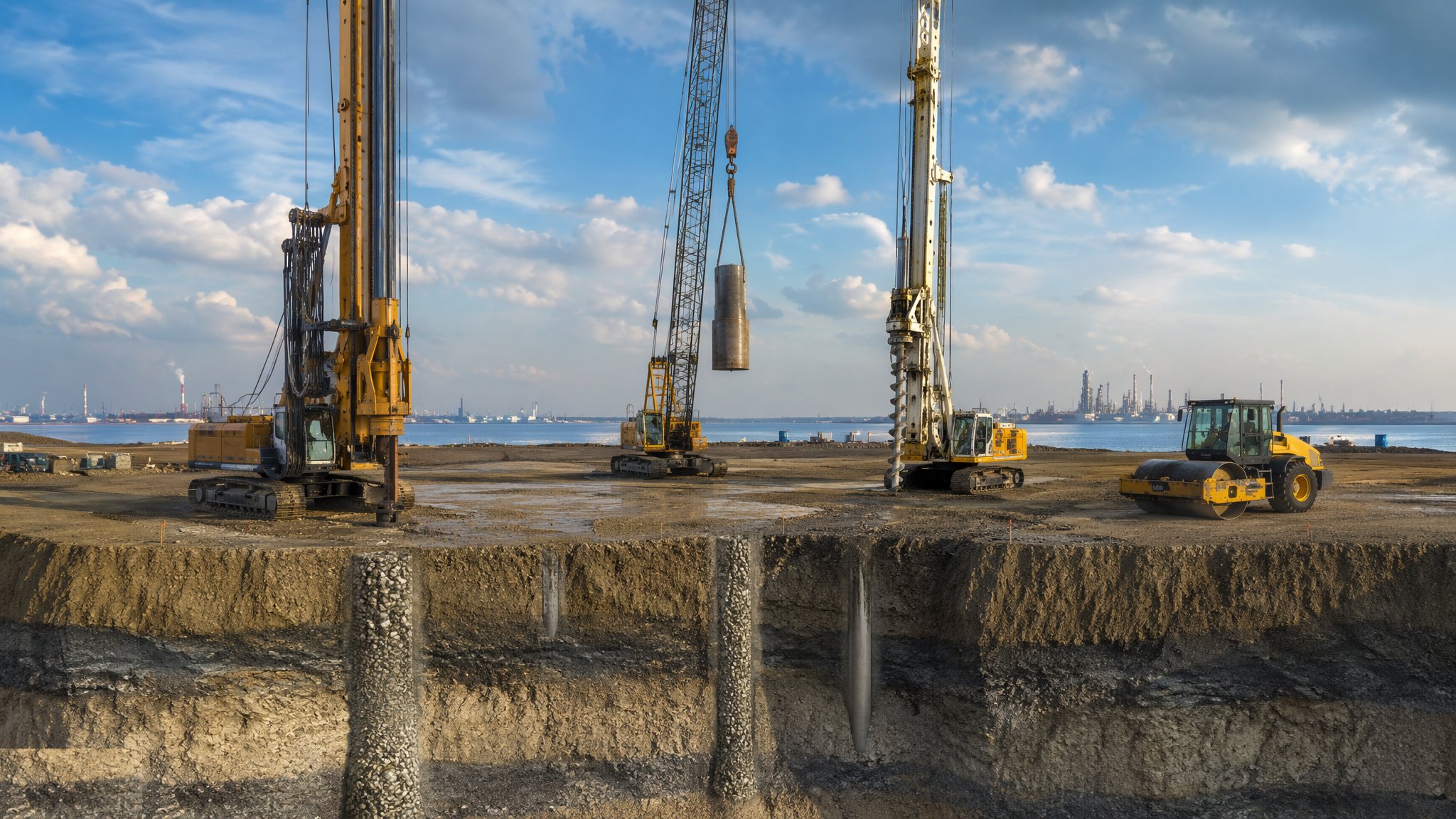
What is Deep soil mixing?
Deep soil mixing turns soft ground into a hardened material without digging it out. A rotating tool with mixing paddles, typically 0.6-1.6 m across on a single shaft and wider again on multi-shaft rigs, is driven into the ground, binder - usually cement, sometimes with lime or other additives - is introduced at the tool, and the two are blended in place. The tool is then withdrawn, mixing again on the way up. What is left behind is a column, panel or block of soil-cement: weaker than concrete by a wide margin - soil-cement strengths are counted in fractions of a megapascal up to a few megapascals, against tens of megapascals for structural concrete - far stronger and stiffer than the ground it replaces, and made from material that never left the site. In the wet method the binder goes in as a slurry, and depths of 20-30 m are routine; in the dry method it is blown in as a powder, takes its water from the wet ground itself, and generally works the top 15-25 m.
The technique earns its place in very soft cohesive ground - soft clays, silts, organic soils, peats and lagoon deposits - the ground where a stone column would find no restraint and where digging out and replacing means moving a great deal of unpleasant material. Overlapping the columns by a nominal 100-300 mm turns them into continuous walls, which is how soil mixing is used for excavation support and for low-permeability cut-offs; mixing the whole volume near the surface is mass stabilisation, generally confined to the top 5-7 m and used under embankments and roads over peat. It struggles wherever the tool cannot mix: coarse gravels, cobbles, rubble fill and buried obstructions all defeat the paddles or leave the binder unevenly distributed.
What makes soil mixing different from the other techniques is that the outcome is chemical as well as mechanical. The strength gained depends on how the binder reacts with that particular soil, and some soils fight back - high organic content, sulfates and certain contaminants all interfere with the reaction, so the ground that most needs treating is often the ground that responds least predictably. That is why the mix is designed on samples in the laboratory first, proved in field trial columns second, and only then put into production. Across the technique as a whole, binder doses run from something like 50 kg to 450 kg for every cubic metre of soil treated, dry mixing at the lower end and wet mixing at the upper - but the dose for a particular soil comes out of the laboratory mix design and the field trial, never off a chart. The binder type and quantity, the mixing energy and the sequence all come from the specialist contractor's design against the geotechnical designer's requirements, and every one of them is recorded by the rig as the work proceeds.
How does Deep soil mixing work, step by step?
- 1
Step 1: Test the soil and design the mix
Samples are taken from each soil horizon that will be treated, mixed with candidate binders in the laboratory, then cured and strength-tested, usually at 7 and 28 days and often at 56 or 90 as well where the soil gains strength slowly. The purpose is not only to find a mix that works but to learn how this soil behaves - whether organics retard it, whether it gains strength slowly, how variable the results are across the site. The geotechnical designer sets the strength and stiffness the treated ground has to reach; the specialist contractor selects the binder, the quantity and the mixing regime that will get there. Laboratory results are always more flattering than the field - it is common for the ground to deliver only a third to a half of what the samples promised - and the design allows for that gap.
- 2
Step 2: Establish the plant and the platform
Soil mixing brings a small batching operation with it: binder silos, commonly 50-100 tonnes apiece, a slurry mixer and pumps for the wet method, or silos with compressed air delivery for the dry method, all with dosing control and recording. Silos need level, stable standing and a delivery route for tankers. The rig itself is heavy and tall - 60-120 tonnes, with a mast reaching well above 20 m on deep work - so the working platform is designed, built and certified before it tracks on, exactly as for any other ground improvement rig. Binder is a dusty, caustic material, so dust control, bunding and washout arrangements are in place before the first column rather than after the first complaint.
- 3
Step 3: Install and test trial columns
Trial columns are installed in ground representative of the worst of the site and left to cure, usually to 28 days and longer where organics are slowing the reaction. They are then cored, or exhumed where they are shallow enough, and tested - which reveals what the laboratory could not: whether the tool is actually mixing out to the edge of the column, whether unmixed lenses of soft soil are being left inside, and whether the strength gained in the field matches the design. Production parameters are fixed from this - penetration rate, rotation speed, binder dose, and the total amount of mixing the soil receives, which is usually counted as the number of blade passes through every metre of column and commonly runs into the hundreds. Trials are the only honest way to find out what the ground does with the binder.
- 4
Step 4: Mix down to depth
The tool is rotated and pushed down to the depth the design requires, breaking up the soil structure as it goes. In the wet method binder slurry is injected at the tool during penetration, during withdrawal, or both, depending on the design. Penetration is slow and deliberate, generally between half a metre and a metre and a half a minute, and the rig logs depth, rotation, penetration rate and binder delivered continuously. A rig in steady production commonly places 100-400 linear metres of column in a shift. Where the tool meets an obstruction it cannot pass, the column is abandoned and its position recorded, because a short column that nobody writes down is a soft spot with a certificate.
- 5
Step 5: Withdraw with re-mixing and form the overlaps
The tool is withdrawn slowly while still rotating, typically at half a metre to three metres a minute, mixing the column a second time and evening out the binder distribution. Where columns have to act together - as a wall, a block or a cut-off - each new column is cut into its neighbour by the nominal 100-300 mm overlap while that neighbour is still fresh, so the two blend rather than butt. The fresh window is short - hours rather than a shift - and that fresh-to-fresh sequence governs the whole production programme. Get it wrong and there is a cold joint through the wall, which for a cut-off means a leakage path and for a retaining block means a plane of weakness.
- 6
Step 6: Cure, core and accept
Treated ground gains strength over time, so testing waits for the age the design specifies - 28 days is the common reference, with 56 or 90 used where organics slow the reaction. Wet grab samples taken from the fresh column, commonly one for every few tens of cubic metres placed, give an early indication; the real verification is coring the hardened columns and testing the recovered material, at the frequency and positions the designer sets - typically something in the order of one column in a hundred to one in several hundred, and always including cores near the edge of the column and through the overlaps, which are the places most likely to disappoint. Results are compared with the acceptance criteria, and shortfalls are re-treated, supplemented or redesigned. The rig records and the core results together are the evidence that the ground below is what the drawings assume.
What are the benefits of Deep soil mixing?
- Treats very soft ground that will not restrain a stone column and would be costly to dig out
- The soil is used in place - no imported fill to bring in, and dry mixing returns almost no spoil at all
- Overlapping columns at a nominal 100-300 mm form continuous walls, so one technique gives both support and a low-permeability cut-off
- Strength and stiffness can be tuned to what the structure needs, rather than taken as found
- Can stabilise and lock up contaminated ground instead of excavating and disposing of it
- Rig instrumentation gives a continuous record of every single column - depth, rotation, rate and binder to the kilogramme
What are the limitations of Deep soil mixing?
- Defeated by cobbles, rubble and buried obstructions, which the mixing tool cannot process
- Organic soils, sulfates and some contaminants interfere with the binder reaction and give erratic strengths
- Strength develops with age, so verification lags production by 28 days or more and problems surface late
- Mixing displaces ground and can heave or move adjacent columns, structures and services
- Binder handling brings dust, caustic burns and a batching plant footprint into the compound, and wet mixing returns 20-50% of the treated volume as alkaline spoil
- The treated ground is only as good as the mixing - unmixed lenses stay invisible until someone cores them
What is Deep soil mixing best suited for?
What plant does Deep soil mixing need?
- Mixing rig of 60-120 t with single-axis or multi-axis tools, 0.6-1.6 m across, on a leader mast
- Binder silos of 50-100 t with dosing, weighing and recording
- Slurry batching and mixing plant with delivery pumps for the wet method
- Compressed air delivery equipment for the dry method
- Excavator and skips for spoil and return material, with washout containment
- Coring rig and a testing laboratory for verification
How is Deep soil mixing quality-checked?
- Laboratory mix design on site-won samples, with the binder selected against measured results at 28 days and beyond
- Field trial columns cored and tested before production parameters are fixed
- Continuous rig records per column - depth, rotation, penetration rate and binder delivered
- Fresh-to-fresh sequence and overlap positions recorded, with any break in sequence flagged
- Cores taken at the specified age - 28 days or later - and at the specified frequency, typically one column in a hundred to one in several hundred, including column edges and overlaps
- Obstructed and abandoned columns logged by position and replaced on the designer's instruction