Vibro stone columns
Stone driven into weak ground in compacted stages - after which the soil and the columns carry the load together.
Last updated 2026-08-25
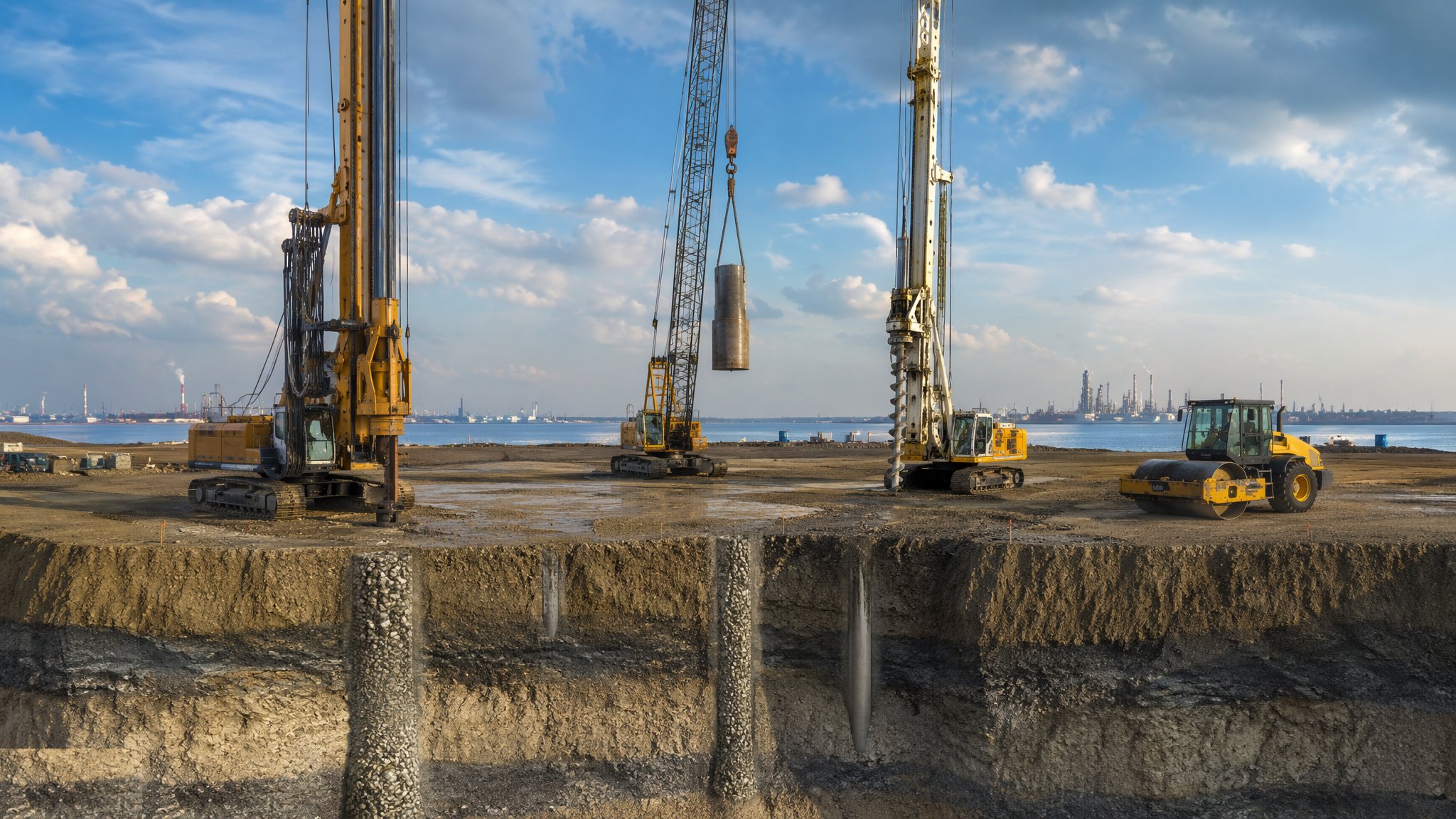
What is Vibro stone columns?
Vibro stone columns treat weak ground by putting something stiffer and stronger into it. A depth vibrator - a heavy steel poker typically 3-4.5 m long and 300-500 mm across, weighing two to four tonnes and shaking sideways rather than up and down - is hung from a crawler rig and penetrates to the depth the geotechnical designer has set, then stone is fed into the bore and compacted in stages as the poker is raised and driven back down. What is left behind is a dense, interlocked stone column, commonly 600 mm to 1.2 m in diameter and generally installed on a grid at something between 1.5 and 3 m centres, bonded into the soil around it. The building above does not sit on the columns alone. Load spreads between the columns and the soil they reinforce, so the whole treated block behaves as one stiffer, stronger mass. Engineers call that composite behaviour; on site it just means the ground stops moving as much as it would have.
The technique does three things at once, and which one matters most depends on the ground. In loose granular fill and made ground the vibration densifies the soil between the columns, so the improvement is as much in the ground as in the stone. In soft cohesive soils the column works mainly as reinforcement, taking a share of the load and shortening the drainage path so that consolidation happens during construction rather than after handover. Stone columns need the surrounding soil to hold them in - the soil provides the lateral restraint that stops the column squeezing outwards under load. That single fact settles most arguments about suitability: the method works well in fills and firm to soft clays, and becomes marginal in very soft, organic or peaty ground where there is little to push back. Depth is the other boundary. Most commercial work treats the top 4-10 m, bottom-feed rigs reach 15-20 m in the right ground, and below that the economics start to swing back towards piling.
Stone columns compete with piling, with rigid inclusions and with simply digging out and replacing. They usually win where the weak layer is not too thick, where the loads are slab and low-rise rather than heavy point loads, and where settlement rather than bearing is the real problem. They lose where the soft layer is deep, where the structure will not tolerate the settlement that composite ground still allows, or where obstructions in the fill stop the poker short. Two things govern the job whatever the ground: the working platform the rig stands on - an engineered element, commonly 600 mm to 1.2 m of well-graded granular fill and sometimes a geogrid beneath it, never a bit of stone thrown down - and the verification regime, because this is a trade where you build the ground and then have to prove you did.
How does Vibro stone columns work, step by step?
- 1
Step 1: Read the ground and fix the design
Ground improvement is designed off the ground investigation, not off a rate. Particle size, fines content, undrained strength, organic content, water level and the depth to a competent stratum all narrow the shortlist, and the settlement the structure above can tolerate narrows it further. The geotechnical designer and the specialist contractor then agree the treatment: which areas get columns, how deep they go, how they are laid out, and what the treated ground has to achieve. Typical schemes put columns on a square, rectangular or triangular grid at 1.5-3 m centres, replacing something like 5% to 15% of the plan area with stone - but every dimension on the design for a particular site comes from their calculations and their experience of the local ground, checked against the same investigation the foundation designer used. An investigation dense enough to design from usually means probes or boreholes at something like 20-40 m centres, closed right up wherever the fill turns variable.
- 2
Step 2: Build and certify the working platform
A vibro rig is tall, heavy and top-loaded, and it stands on the softest ground on the project - which is the whole reason it is there. The platform is a designed structure: typically 600 mm to 1.2 m of well-graded granular material, sometimes over a geogrid or geotextile, laid on a proven formation, with ramps at a gradient the rig can climb loaded and an engineered stand-off from any open excavation. A vibro rig weighs 30-60 tonnes with the poker hung, and nearly all of that arrives through a small track footprint. It is signed off in writing before the rig tracks on, inspected while the works run, and reworked and re-certified when rig traffic ruts it. The fatal accidents in this trade are rig overturns on platforms that were adequate on day one and were never looked at again.
- 3
Step 3: Prove the design in a trial
Before production starts, trial columns are installed at the design layout in a representative area and tested. The trial answers questions no calculation can: whether the poker reaches design depth without refusing on buried obstructions, how much stone the ground actually takes - in the order of a tonne for every metre of column is a common starting expectation - how long a column takes, which at production depths is usually a matter of minutes rather than an hour, and whether the treated ground performs as assumed. Production parameters - the criteria for depth, for stone consumption and for compaction - are set from the trial and written down. A trial that fails is cheap. Discovering the same failure under a finished floor slab is not.
- 4
Step 4: Penetrate to depth, top-feed or bottom-feed
The poker is vibrated down under its own weight, with air or water flush assisting, displacing and densifying as it goes. Where the bore stands open in stable ground, stone - clean, single-sized crushed rock or crushed concrete, typically around 40-75 mm - is tipped in from the surface around the poker. That is the top-feed method: quick and cheap, but reliant on the hole staying open. Where the ground is soft or wet and the bore would collapse, the bottom-feed method delivers smaller stone, typically 20-40 mm so that it will pass down the delivery tube, straight to the tip of the poker, which never leaves the hole. The choice belongs to the specialist contractor and follows the ground and the water level, not the price list.
- 5
Step 5: Build the column in compacted stages
The column is not backfilled in one go. The poker is raised a short distance - commonly 0.3-1 m - a charge of stone is placed, and the poker is driven back down through it to compact the stone and force it outwards into the surrounding soil. That re-plunging is the whole technique - it is what makes the column dense and what locks it into the ground. The rig records what it does: depth reached, the current the vibrator draws as it compacts, and the stone taken at each stage. Those records are the first quality document on the job, and a column that took far more or far less stone than its neighbours is where the investigation starts. A rig in steady production commonly places 150-400 linear metres of column in a shift, so a 5,000 m² warehouse slab treated at 2 m centres - something over 1,200 columns - is three to six weeks of work once the platform is signed off.
- 6
Step 6: Verify the treated ground and cap it
Verification is agreed before mobilisation and executed as the work proceeds: penetration testing before and after treatment to show the change in the soil between the columns, typically one profile for every few hundred to a couple of thousand square metres treated; plate load tests on individual column heads, commonly at something like one column in fifty to one in a few hundred; and one or more zone tests loading a group of columns together under kentledge - often tens of tonnes of it - to prove the composite behaviour the design assumed. The rates for a particular job belong to the specification and are agreed before the rig arrives, not negotiated after a disappointing result. Results are assessed against the acceptance criteria with the designer, and shortfalls are re-treated rather than argued about. The treated area is then blinded or capped and protected, because treated ground left open to weather and site traffic is treated ground being spoiled.
What are the benefits of Vibro stone columns?
- Far cheaper and faster than piling where the weak layer is shallow enough to treat through - usually the top 4-10 m
- Reinforces and densifies the soil as well as adding columns, so the whole block stiffens
- Stone columns drain, bringing consolidation settlement forward into the construction period
- Uses stone rather than concrete, with lower embodied carbon than an equivalent piled solution
- Rigs are relatively mobile, and at 150-400 linear metres of column a shift a large slab area is covered quickly once the platform is right
- Copes with variable made ground that would force conservative assumptions across a whole piling scheme
What are the limitations of Vibro stone columns?
- Needs the surrounding soil to restrain the column - very soft, organic and peaty ground is marginal or unsuitable
- Obstructions in made ground stop the poker short, and a column that does not reach design depth is not a column
- Settlement is reduced, not eliminated - tight differential settlement criteria may still force piling
- Vibration and noise carry to neighbours, and buried services have to be located and stood off by whatever distance the vibration assessment sets - several metres at least, and often ten or more
- Water flush and displaced spoil have to be contained, settled and disposed of
- Depends on a designed and maintained working platform, which is a cost and a programme item in its own right
What is Vibro stone columns best suited for?
What plant does Vibro stone columns need?
- Crawler base machine of 30-60 t carrying a depth vibrator on a fixed mast or a free-hanging leader
- Depth vibrators of 3-4.5 m and 300-500 mm diameter, top-feed or bottom-feed, with their stone delivery gear
- Loading shovel or excavator feeding the stone hopper, with clean single-sized stone stockpiled - typically 40-75 mm for top-feed, 20-40 mm for bottom-feed
- Compressor or water flush plant, with containment and settlement for return water
- Dozers and rollers for the 600 mm to 1.2 m working platform and for regulating the treated surface
- Penetration testing rig, plate load equipment and kentledge for zone testing
How is Vibro stone columns quality-checked?
- Working platform designed, certified in writing and re-inspected through the works
- Trial columns installed and tested, with production parameters set from the results
- Per-column rig records - depth, compaction current and stone consumed - reviewed daily, not filed blind
- Pre- and post-treatment penetration profiles on the same lines, typically one per few hundred to a couple of thousand square metres, compared against the acceptance criteria
- Plate load tests on individual columns - commonly one in fifty to one in a few hundred - and at least one zone test on a group of columns under kentledge
- Stone gradation and cleanliness checked on delivery, with fines held to a few percent at most - fines in the stone destroy both stiffness and drainage
More ground improvement techniques methods
Next method
Dynamic compaction