Ground freezing
Freeze the water in the ground and the ground becomes a wall - strong, watertight and entirely temporary.
Last updated 2026-08-25
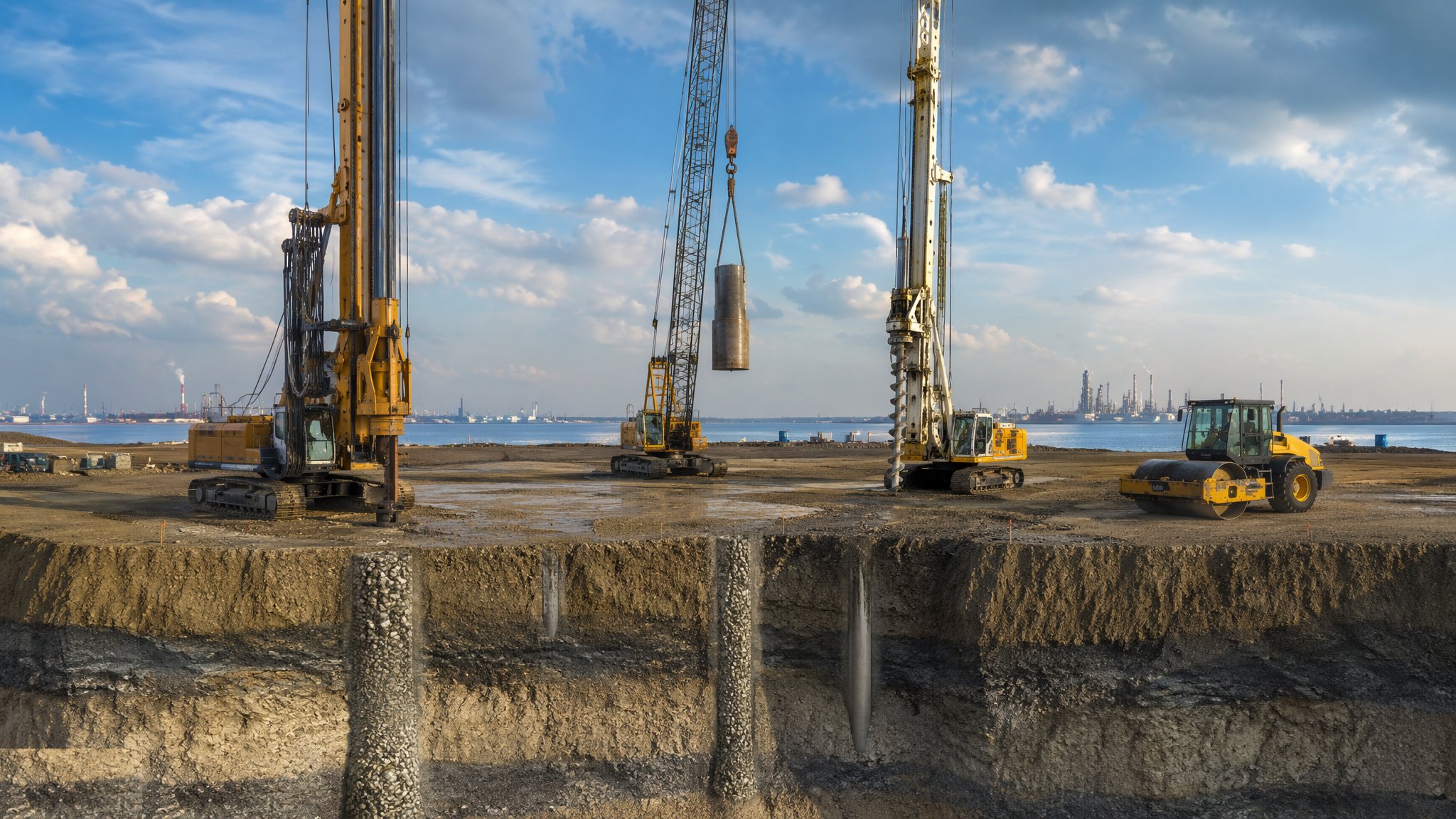
What is Ground freezing?
Ground freezing makes a structure out of the ground itself by turning the water in its pores to ice. A ring or line of freeze pipes - typically 100-150 mm casings with an inner feed tube, set at something like 0.8-1.5 m centres - is drilled into position, a refrigerant is circulated through them, and the ground around each pipe cools until ice begins to form. The frozen zones grow outwards at a few centimetres a day, meet between adjacent pipes and merge into a continuous frozen wall, commonly one to two and a half metres thick by the time it is proved. That wall does two jobs at once: it carries load, because frozen saturated sand reaches compressive strengths of a few megapascals, concrete-like in the short term, where the same ground thawed has almost none, and it is effectively watertight, because there is no longer any liquid water free to flow. When the permanent works are finished the plant is switched off, the ground thaws, and nothing is left behind but the pipes.
Two approaches are used. The common one circulates a chilled brine, at around twenty to thirty-five degrees below zero, through a closed loop from a refrigeration plant on the surface: slow to establish - four to twelve weeks to close a wall is a normal expectation - but controllable, economical to hold once cold and suited to work lasting months. The other injects liquid nitrogen directly into the pipes at close to two hundred degrees below zero and vents the gas to atmosphere: it closes a wall in days rather than weeks, needs no refrigeration plant, and consumes nitrogen by the tonne for every cubic metre of ground frozen - so it is used for short durations, for emergencies, and for closing a stubborn gap the brine system cannot reach. Both need the same thing from the ground: water in the pores, and not too much of it moving. Flowing groundwater carries heat to the freeze front continuously, and seepage much above a metre or two a day starts to defeat a brine system altogether - the ice will simply never close.
Ground freezing competes with dewatering, cut-off walls, jet grouting and compressed air, and it tends to win in water-bearing ground where the geometry is awkward, the depth is severe, or where injecting anything into the ground is unacceptable. Shafts, cross-passages between tunnels, tunnel eyes and deep excavations in saturated sands are its natural home. What has to be respected is that the ground changes shape twice. Water expands by about 9% when it turns to ice, and in frost-susceptible silts ice lensing multiplies that, so the ground heaves as the wall forms and can lift services and structures above it. When the freeze is released the ground thaws and consolidates, and settlement follows - which is why the thaw is designed and monitored as carefully as the freeze, and why grouting on thaw is often part of the scope. It is also a technique with no tolerance for a power cut: the frozen wall exists only while the plant is running.
How does Ground freezing work, step by step?
- 1
Step 1: Confirm the ground and the groundwater will allow it
The investigation has to establish the pore water present, the grain size and, above all, the groundwater flow, because moving water is what defeats a freeze. Saline or contaminated pore water depresses the freezing point and slows everything down. The geotechnical designer models the thermal behaviour and the strength of the frozen ground under the loads it will carry, and sets the wall geometry, the freeze pipe arrangement - spacings of around 0.8-1.5 m are typical for brine and closer for nitrogen - and the temperatures the ground has to reach. Where groundwater flow is too high, and a metre or two a day is enough to cause trouble, it is reduced first or the method is changed.
- 2
Step 2: Drill and survey the freeze pipes
The freeze pipes are drilled and installed - commonly to 10-40 m on shaft and cross-passage work, and far deeper on mining jobs - and every one of them is surveyed for position and deviation over its full length. This is the step that decides whether the job works. Two pipes that drift apart at depth leave a window where the ice never closes, and water will find that window at the worst possible moment: at 30 m, a drift of one percent on each of two adjacent pipes adds more than half a metre to the gap between them, which on a spacing of about a metre is enough to leave the ice short. Where deviation exceeds what the design allows, additional pipes are installed to fill the gap. The pipes are pressure-tested before they go into service, because a leaking pipe loses coolant into the ground and stops the freeze locally.
- 3
Step 3: Install monitoring and commission the plant
Temperature sensors are installed in dedicated holes through the wall and at its edges, typically strung at a metre or two of vertical spacing so the profile can be read at every level, with further instrumentation monitoring ground movement and, usually, water level or pressure inside the ring. The refrigeration plant - a few hundred kilowatts of refrigeration is a typical duty for a shaft - along with the headers and manifolds, is commissioned with standby capacity and standby power, because an interrupted freeze is a wall quietly opening. Alarm limits and the response to them are agreed and written down before the plant is started. From this point the job runs continuously, day and night, until it is released.
- 4
Step 4: Freeze to closure and prove it
Active freezing runs until the temperature records show a continuous wall of the thickness the design requires - four to twelve weeks on brine, and days to a fortnight on nitrogen. Closure is confirmed, not assumed - the temperature profiles between pipes are read against the design, and where the ring encloses a volume, the water level or pressure inside it changes once the ring seals, which is direct evidence the wall has closed. Nobody excavates on the strength of a programme date. Ground heave is monitored throughout the active freeze, and services or structures above the works are watched against agreed triggers.
- 5
Step 5: Excavate under a maintained freeze
Once the wall is proved, the plant drops back to maintenance duty, holding the wall while excavation and the permanent works proceed inside it. Temperatures are read continuously and the exposed face is inspected: seepage, a wet patch or a face that looks warm are all early warnings. Frozen ground creeps under sustained load, so movement of the wall is monitored and the excavation is not left open longer than the design allows. Heat sources inside the excavation - plant exhausts, lighting, a large concrete pour giving off real heat as it cures - are managed, because every one of them works against the freeze.
- 6
Step 6: Thaw under control and close out
When the permanent works can carry the ground, the freeze is released, either passively - which takes as long as the freeze did and usually longer - or with heat applied where the programme demands it. Thaw is the second movement event: the ground consolidates as the ice melts, so settlement is monitored and, where necessary, compensated by grouting through the same or additional holes. The freeze pipes are removed or grouted up, and the full record - pipe surveys, temperature history, movement monitoring and the thaw record - is archived, because it will be read by whoever next builds nearby.
What are the benefits of Ground freezing?
- Gives strength and a water cut-off from one operation, in ground where both are hard to achieve
- Nothing is injected into the ground, so it suits sites where grout or slurry would be unacceptable
- The wall can be formed in almost any geometry, including curved and inclined shapes
- Works at depths and water pressures that defeat most other temporary works solutions
- Fully reversible - once thawed, the ground is left much as it was found
- The state of the works is continuously measurable through the temperature record
What are the limitations of Ground freezing?
- Flowing groundwater carries heat away and can prevent the wall from ever closing - a metre or two a day is enough to cause trouble
- Entirely dependent on continuous power and plant - an interruption is a live structural risk
- Freeze heave lifts the ground and thaw settlement drops it, so movement is a two-stage problem
- Slow to establish with brine - four to twelve weeks before anyone can dig - and expensive to run with liquid nitrogen
- Freeze pipe deviation leaves unfrozen windows that stay invisible until water finds them
- Strictly temporary - the moment the plant stops, the works begin losing their support
What is Ground freezing best suited for?
What plant does Ground freezing need?
- Drilling rig capable of installing 100-150 mm freeze pipes to close tolerance, with a deviation survey system
- Refrigeration plant of a few hundred kilowatts, brine circulation pumps, headers and insulated manifolds
- Or liquid nitrogen storage, distribution and venting, with oxygen depletion monitoring
- Temperature sensor strings at a metre or two of vertical spacing, data loggers, alarms and telemetry
- Standby power generation and standby refrigeration capacity
- Ground movement instrumentation and grouting plant for the thaw phase
How is Ground freezing quality-checked?
- Groundwater flow assessed and confirmed to be within what the design allows
- Freeze pipe position and deviation surveyed over the full length, with infill pipes where required
- Freeze pipes pressure-tested before commissioning
- Closure of the frozen wall verified from temperature profiles before any excavation begins
- Continuous temperature, movement and plant-status logging, with alarms and a written response
- Thaw settlement monitored and any compensation grouting recorded through to close-out