Caissons
A structure that digs itself into the ground - excavate inside it and let its own weight take it down.
Last updated 2026-09-05
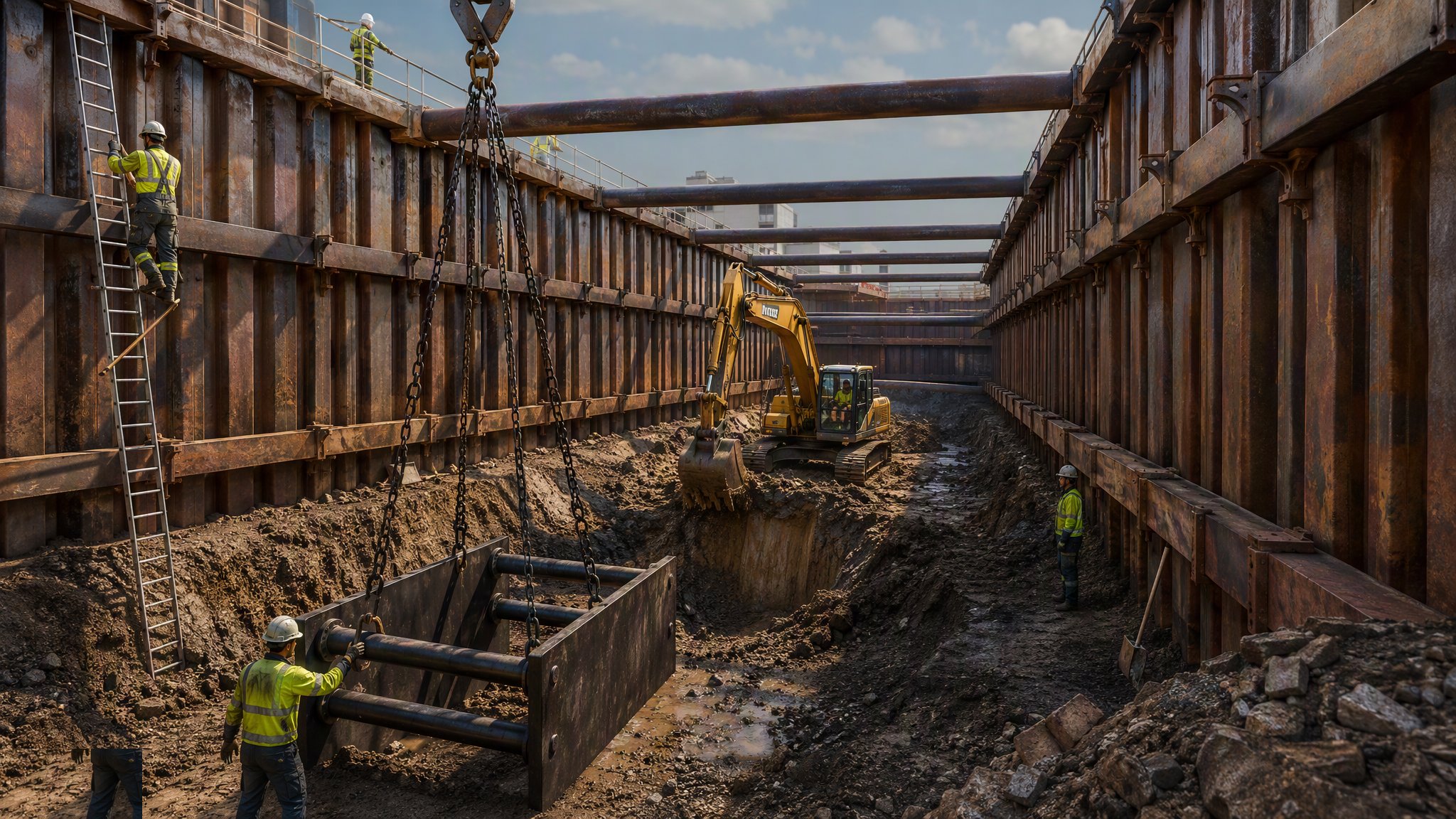
What is Caissons?
A caisson is a rigid box or cylinder - commonly 3-12 m across internally for a shaft, and a great deal larger for a bridge pier - that is sunk into the ground by excavating from inside it, rather than by building it into a hole that already exists. The walls are built at the surface, with a cutting edge at the bottom, and as material is dug out beneath and inside them the structure descends under its own weight. More wall is added at the top as it goes, in lifts or precast rings of typically 1-2.5 m, so the excavation is always supported by a wall that is already in place. It is the opposite way round to almost every other form of shaft or deep excavation, and that is precisely why it is used: there is never an unsupported face.
There are three broad families. An open caisson is open at both ends and is sunk by digging out through the top, in the dry or under water, and it is the common form for deep shafts, pumping stations and large chambers, routinely to 15-30 m and past 40 m on major work. A box caisson is closed at the bottom, built or floated to position and lowered onto a prepared bed, and is used for marine structures and bridge piers where the founding level can be prepared in advance. A pneumatic caisson has a sealed working chamber pressurised to hold the water back so the base can be worked in the dry - a highly specialised and tightly regulated activity, with its own medical and access regime, used only where nothing else will reach.
A caisson is chosen where the ground is too wet, too soft or too deep for a cofferdam, where the plan area is small relative to the depth, or where the structure has to be founded through water. It is a slow, patient technique and the risk sits in the sinking rather than in the digging. A caisson in favourable ground comes down a metre or two a shift; in stiff clay, or once friction has built up, it can be a fraction of that, so a 20 m shaft is commonly two to three months of sinking rather than a few weeks of it. The two things a junior engineer does not expect are that a caisson that has stopped sinking is more dangerous than one that is moving, because friction is holding it and it will release without warning, and that correcting tilt is far harder than preventing it. Weight, penetration, wall thickness, lift heights and every load in the sinking calculation come from the temporary works designer and the specialist contractor.
How does Caissons work, step by step?
- 1
Step 1: Design the sinking, not just the shaft
The finished shaft is the easy part. What has to be designed is the descent: the self-weight available at every stage against the friction on the outside and the resistance under the cutting edge, so the caisson keeps moving without needing an unsafe amount of excavation below the edge. The designer sets the wall build-up - commonly a few hundred millimetres to over a metre thick, because the wall is retaining the ground, providing the weight that drives the descent and forming the permanent structure all at once - along with the cutting edge, the lift heights, whether kentledge or jacking will be needed, and what is done if it sticks. Ground investigation matters more here than almost anywhere else, because a single obstruction under one side of a cutting edge is what starts a tilt.
- 2
Step 2: Prepare the base and cast the cutting edge
A level, well-drained pad is prepared and the cutting edge and first lift are built on it. The cutting edge is a shaped, heavily reinforced ring designed to slice into the ground and to take a very concentrated load when the caisson is bearing on one point. That first lift is usually 1.5-3 m high, enough to be stable and heavy enough to bite, and getting it exactly level and exactly on position is the single best investment in the whole operation - the caisson will follow whatever attitude it starts with, and a lean built in at the surface grows all the way down. Survey control is established here and re-used at every subsequent lift.
- 3
Step 3: Excavate inside and let it sink
Material is taken out from inside using a grab, a long-reach excavator or, below water, by dredging without dewatering. The excavation pattern is the steering wheel: digging evenly around the inside keeps the caisson upright, and taking material from one side is how you correct a drift or, if you get it wrong, how you cause one. Excavation below the cutting edge is controlled tightly, because undermining the edge to get the caisson moving is what turns a stall into a sudden drop. Progress, verticality and plan position are surveyed at frequent intervals - commonly every half metre of descent and at every shift change - not at the end of each lift.
- 4
Step 4: Build the next lift and manage the friction
As the top of the caisson approaches ground level, the next lift is built or the next precast ring is placed and jointed, adding weight and depth together. Friction on the outside grows with depth and can stop the descent entirely. The remedies are all planned in advance by the designer: a slight step in the wall - typically 50-100 mm on the radius - so the shaft below is narrower than the cut above, lubricating fluid injected into that annulus, added kentledge running to tens or hundreds of tonnes, or hydraulic jacking off ground anchors. What is never a remedy is digging deeper under the edge and hoping. A stalled caisson is treated as a controlled operation with everybody clear of the base.
- 5
Step 5: Reach founding level and seal the base
The last stage is confirmed against the ground the designer assumed, by inspection or by probing ahead. Where the caisson has been sunk in the dry the base is cleaned and blinded; where it has been sunk full of water, a concrete plug is placed under water through a tremie and allowed to gain strength - commonly a week or more, with the age the designer's call - before any pumping starts. That plug does two jobs - it seals the base and it holds the caisson down. Pumping out a sealed caisson makes it buoyant, and the check that it will not float is done before the pumps go on, not after the water level has dropped.
- 6
Step 6: Fit out, connect and reinstate outside
With the base dry, the permanent internals go in: base slab, benching, pipework, penetrations through the wall and any internal structure. Connections out through the shaft wall are formed and sealed to the designer's detail, and are a common leakage point later. Outside, the annulus left by the sinking is grouted or backfilled so the ground is not left loose around the shaft, and the ground surface and any services displaced by the operation are reinstated. Ground movement monitoring around the caisson continues until the readings settle.
What are the benefits of Caissons?
- The excavation face is supported by permanent wall at every stage - there is never an open unsupported face
- Reaches depths in soft, wet or running ground where a braced cofferdam would be impractical
- Small plan footprint at ground level for a deep structure, which suits congested and urban sites
- Sinking under water avoids drawing the water table down and disturbing neighbouring ground
- Box caissons can be built or floated in and placed on a prepared bed, taking heavy work out of the water
- The sunk structure is usually the permanent structure, so nothing is installed twice
What are the limitations of Caissons?
- Slow, and progress is difficult to predict because friction and obstructions govern the rate - a metre or two a shift in good ground, far less in stiff clay
- Tilt and plan drift are far easier to cause than to correct, and a corrected caisson still costs programme
- Obstructions and boulders under the cutting edge stop the sinking and are hard to remove safely
- A stalled caisson can release suddenly, which is why nobody works under the cutting edge
- Buoyancy after base sealing has to be checked before dewatering, and a floated caisson is a serious event
- Pneumatic working is a specialised regulated activity with its own medical, training and access regime
What is Caissons best suited for?
What plant does Caissons need?
- Crawler crane of 50-100 t with clamshell or grab, and long-reach excavators for in-the-dry excavation
- Precast rings or formwork and reinforcement for in-situ lifts of typically 1-2.5 m, with a shaped, heavily reinforced cutting edge
- Hydraulic jacking frames, thrust rings and ground anchors, or kentledge, to drive a stalled caisson
- Tremie plant for the underwater base plug, and submersible pumps for dewatering afterwards
- Survey instruments set on fixed control, with targets on the caisson for verticality and plan position
- Confined-space entry, gas monitoring, rescue equipment and designed access to the working level
How is Caissons quality-checked?
- Cutting edge and first lift surveyed for level and position before any sinking begins
- Sinking log kept continuously - depth, verticality, plan position and what was excavated where
- Excavation below the cutting edge kept within the designer's written limits, with nobody working beneath it
- Joints between lifts or rings inspected and sealed, since these are the leakage paths in service
- Base plug placed, checked for integrity and confirmed against uplift before pumping out
- Ground movement and services around the caisson monitored against agreed triggers throughout the sinking