Trench boxes and drag boxes
Proprietary boxes lowered into a trench to protect the people working inside it, and dragged forward as the work advances.
Last updated 2026-09-05
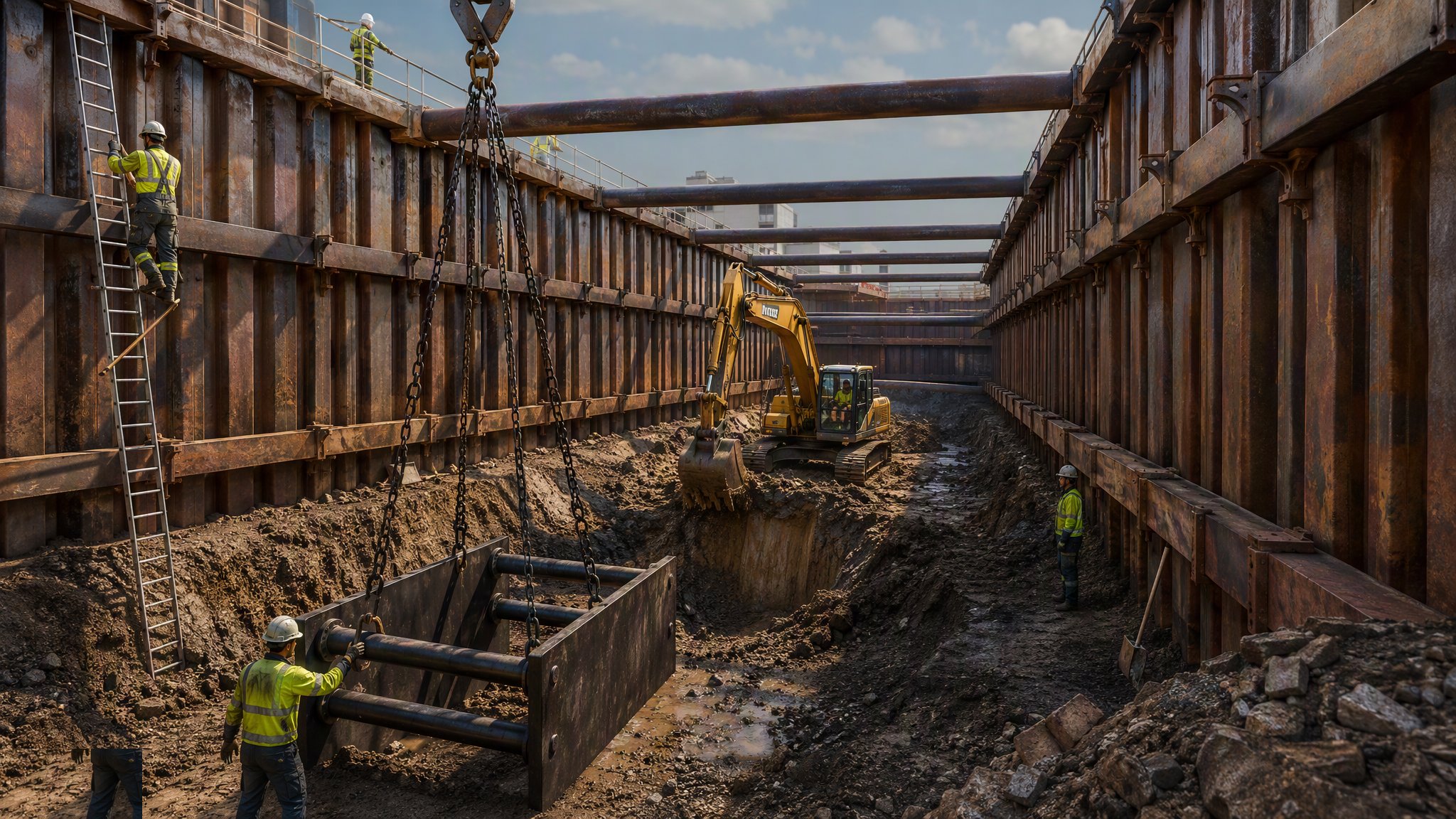
What is Trench boxes and drag boxes?
A trench box is a proprietary steel or aluminium structure - two side panels held apart by struts - that is lowered into a trench so that the people working in it are inside a protected space. A drag box is the same idea arranged so that it can be pulled along the trench as the work moves forward, which suits continuous operations such as pipelaying where the working point advances steadily. Both are equipment rather than earthwork support in the strict sense. Their purpose is to protect the operatives from a collapse, not necessarily to hold the ground where it is, and understanding that distinction is the key to using them properly.
That distinction has a practical consequence. Because a box protects the space it encloses, the ground outside it can still move, and the surface behind the trench can still settle. Where there is a structure, a road or a service nearby that cannot tolerate movement, a box may protect the workforce while doing nothing for the neighbour, and a different system is needed. It also means the box only protects people who are inside it. Stepping outside the box in an open trench, even briefly, even to reach a fitting a short distance away, puts a person in exactly the position the box exists to avoid, and that is where a large share of trench fatalities occur.
Trench boxes are used correctly only within the conditions the temporary works designer has set and the manufacturer's instructions allow. The designer establishes whether a box is appropriate for that trench in that ground with those surroundings, which box arrangement is suitable, and how it is to be installed and removed. That design is checked and recorded on the temporary works register like any other. The box is assembled and used strictly as the manufacturer requires, because it is certificated equipment and changing it invalidates everything known about it. And the constant applies here as everywhere else in this trade: the excavation is inspected by a competent person before anyone enters it and at the required intervals thereafter, and nobody enters an unsupported trench.
How does Trench boxes and drag boxes work, step by step?
- 1
Step 1: Establish the ground, the services and what is nearby
Before any trench is opened the ground is investigated and the buried services are located and marked using the available records and detection, then proved as the works require. What stands near the trench line matters as much - buildings, walls, poles, road edges and other structures all fall within the zone an excavation influences. Where settlement behind the trench cannot be tolerated, that is established now, because it may rule a box out before anything is ordered.
- 2
Step 2: Have the excavation and the box arrangement designed
The temporary works designer decides whether a box is the right system for that trench, which arrangement is required, and how it will be installed and removed. The design takes account of the ground, the water, the surroundings, the plant available and the way the work will advance. It is independently checked to the level the temporary works coordinator sets and entered on the temporary works register. The manufacturer's instructions and limitations for the specific equipment form part of that design basis and are on site with the box.
- 3
Step 3: Assemble the box exactly as the manufacturer requires
Boxes are certificated equipment. They are assembled from matched components using the manufacturer's pins, struts and connections, and they are used within the manufacturer's stated limitations. Components are inspected before use and damaged or distorted parts are taken out of service rather than straightened. Mixing components from different systems, substituting parts, extending struts beyond what the manufacturer allows or modifying a box in any way removes every guarantee the certification provides, and it is not done.
- 4
Step 4: Install the box by the designed method, from outside the trench
The box is placed by the method the design specifies and always from outside the excavation. Nobody stands in an unsupported trench to guide, position or connect a box. Lifting is planned, with the lifting points the manufacturer specifies, and the excavator or crane used is suitable for the weight and reach. The relationship between digging and placing the box follows the design, so that the trench is not left open and unprotected while equipment is being manoeuvred.
- 5
Step 5: Keep people inside the protected space
The box protects the space it encloses and nothing else. The rule on site is simple and absolute: work happens inside the box, and nobody steps outside it into open trench. Where the working point moves beyond the box, the box moves too. Access and egress are provided within the protected space by ladders positioned as the design requires and secured, and the route out is kept clear at all times, because a trench collapse gives no warning and no second chance.
- 6
Step 6: Advance the box as the work moves forward
In a drag arrangement the box is pulled forward as the pipe or service is laid behind it, again by the designed method and again with nobody in unprotected ground. The trench behind the box is backfilled as the work advances rather than left open, which reduces both the length of open excavation and the time the surrounding ground is unsupported. The advance rate follows the design and the ground, not the delivery schedule.
- 7
Step 7: Manage spoil, plant, water and the surface around the trench
Spoil and materials are kept back from the trench edge by the distance the design requires, and plant and site traffic are controlled so they do not load or vibrate the ground beside the trench. Surface water is diverted away from the excavation, water entering it is removed within the limits the design allows, and any change in the ground - seepage, softening, running sand, tension cracking at the surface - stops work and is reported to the designer.
- 8
Step 8: Inspect throughout and remove the box as designed
A competent person inspects the excavation before anyone enters, at the start of each shift and after any event that could affect it, and the inspection is recorded. Removal of the box follows the designed method, is carried out from outside the trench, and is coordinated with backfilling so the ground is not left open behind it. The trench is then backfilled and compacted as required, the surface is reinstated, and the register entry is closed out.
What are the benefits of Trench boxes and drag boxes?
- Provides a protected working space for operatives without needing to batter the trench sides back
- Fast to place and to move, which suits pipelaying and other continuously advancing works
- Needs far less surface width than a battered excavation, so it works in roads and confined corridors
- Certificated proprietary equipment with known capabilities, reused across many projects
- Installed and removed from outside the excavation, so nobody enters unsupported ground
- In a drag arrangement the trench behind can be backfilled as the work advances, shortening the open length
What are the limitations of Trench boxes and drag boxes?
- Protects the space inside the box - it does not necessarily prevent movement of the ground outside it
- Unsuitable where nearby structures, roads or services cannot tolerate settlement behind the trench
- Offers no protection at all to anyone who steps outside it, which is where many trench fatalities occur
- Boxes are heavy, so placing and moving them needs suitable lifting plant and a planned lift
- Must be used strictly within the manufacturer's limitations - modified or mismatched boxes are not certificated
- Obstructs the trench, which can complicate laying, jointing and connections within the protected space
What is Trench boxes and drag boxes best suited for?
What plant does Trench boxes and drag boxes need?
- Proprietary trench boxes or drag boxes with the manufacturer's matched struts, pins and connections
- Excavator or crane of suitable capacity and reach for placing and moving the boxes
- Certified lifting accessories used at the manufacturer's designated lifting points
- Ladders and access equipment for entry and egress within the protected space
- Pumping and surface water diversion equipment within the limits the design allows
- Service detection equipment, barriers, edge protection and traffic management
How is Trench boxes and drag boxes quality-checked?
- Services located, marked and proved, and nearby structures surveyed, before the trench is opened
- Design and box arrangement produced, independently checked and held on the temporary works register
- Manufacturer's instructions and limitations available on site and followed without modification
- Components inspected before use, with damaged or mismatched parts taken out of service
- Installation and removal carried out by the designed method entirely from outside the excavation
- Competent person inspection before entry, at the start of each shift and after any affecting event, recorded
- Spoil, plant and traffic kept back from the edge as the design requires, and ground changes reported