Trench sheets and sheet piling for short-term works
Interlocking sheets driven into the ground to hold the sides of an excavation for the duration of the works, then extracted.
Last updated 2026-09-05
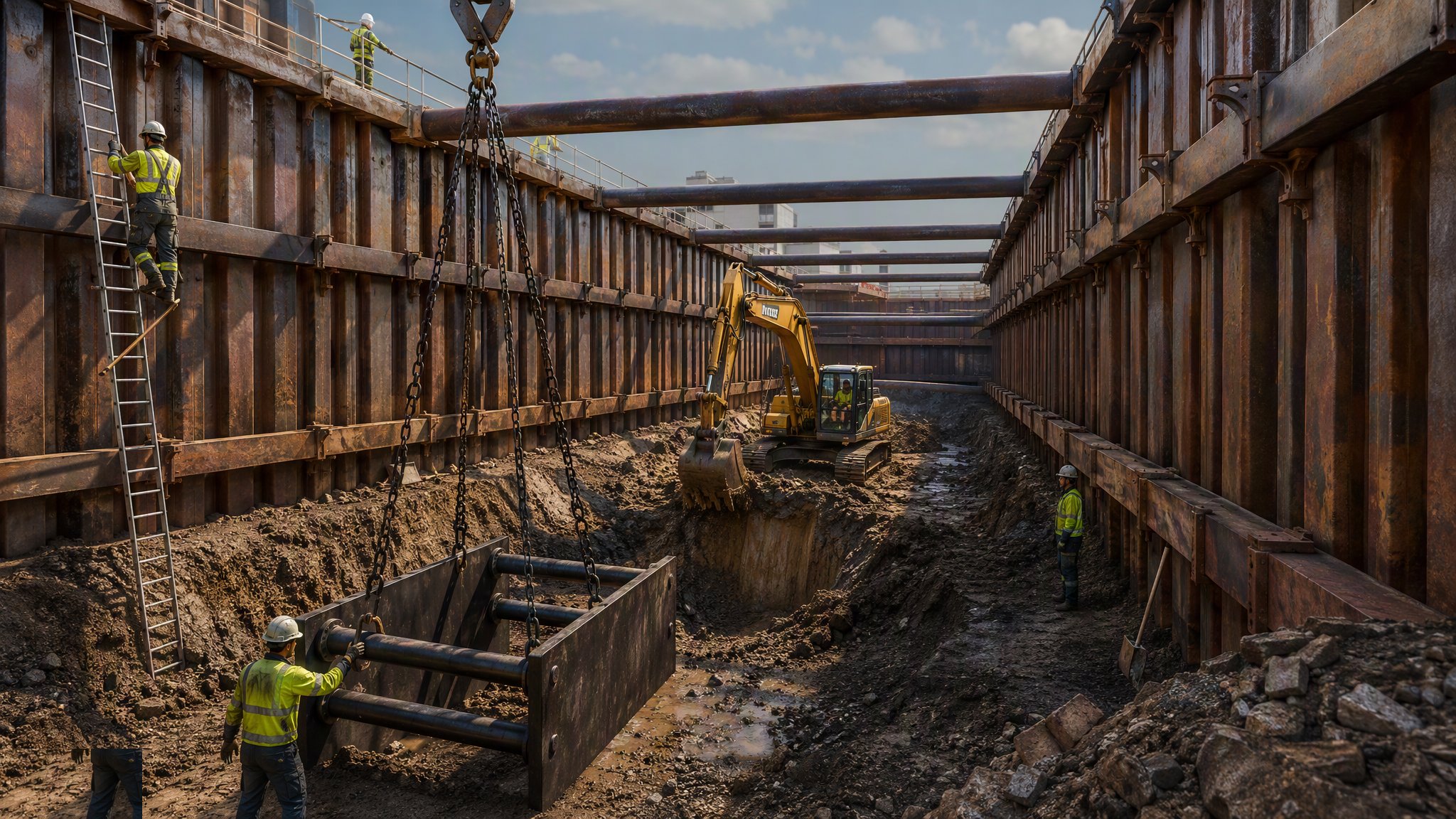
What is Trench sheets and sheet piling for short-term works?
Trench sheets and sheet piles are interlocking steel sections driven into the ground before the excavation is dug, so that the ground is supported by a continuous wall rather than by something placed into an already-open hole. Trench sheets are the lighter sections used for shallower work; sheet piles are the heavier sections used where more is being asked of the wall. Used as temporary works, they go in, they hold the ground while the pipe, chamber, structure or connection inside is built, and then they come out to be used again. The same product used permanently stays in the ground, but that is a different design problem with different considerations.
The characteristic that sets driven sheeting apart from boxes and frames is that it is installed before the ground is opened. That makes it the system of choice where the excavation cannot be dug first: where water has to be kept back, where running sand would not stand for long enough to place anything into it, or where the ground behind the excavation must be held still because a road, a building or a service is close by. A continuous driven wall supports the whole face rather than only the working space, and where the design provides for it, it can also cut off or slow the water trying to get in. That combination is why sheeting is so often the answer on constrained urban sites.
It is also the system with the most going on around it. Driving sheets makes noise and vibration that carries to neighbours and to buried services, and the vibration assessment and any monitoring regime come from the designer rather than from experience. Obstructions in the ground can stop a sheet short, which is a design issue and not a driving issue. The wall usually needs support from walings and struts inside the excavation as it goes deeper, installed to the designed sequence. And extraction, at the end, is the most hazardous phase of all - support is being pulled out of ground that has been open for weeks, with the surrounding ground and services still relying on it. Every stage is designed, checked, held on the temporary works register, inspected by a competent person and released under permit, and nobody enters the excavation until the support is in and signed off.
How does Trench sheets and sheet piling for short-term works work, step by step?
- 1
Step 1: Investigate the ground, the water and everything nearby
The investigation establishes the soil, the water regime and the presence of obstructions, all of which govern whether sheeting can be driven at all. A survey establishes the buildings, walls, roads, drains and buried services around the excavation, and how sensitive each is to vibration and to ground movement. Because driving is a vibrating operation carried out close to things that do not like vibration, this survey is one of the main inputs to the design and often decides the driving method.
- 2
Step 2: Design the sheeting, its support and the whole sequence
The temporary works designer sets the sheeting arrangement, the support it needs inside the excavation as the dig proceeds, the sequence of driving, excavating, supporting and later extracting, and what may be placed or operated near the edge. The design covers the water as well as the ground. It is independently checked at a level matching the risk and entered on the temporary works register, together with the equipment limitations and the vibration assessment.
- 3
Step 3: Assess vibration and agree monitoring before driving starts
The vibration assessment establishes what the driving operation will do to the structures, services and occupiers around it, and sets the stand-offs, the driving method and the monitoring regime. Pre-condition surveys are carried out on structures that could later claim damage. Monitors go in at the sensitive receptors with trigger levels set by the designer and a named person who receives the alerts. Occupiers and service owners are told what is happening and when. All of this happens before the first sheet is driven, not after the first complaint.
- 4
Step 4: Set out and drive the sheets to the designed method
The sheets are pitched and driven by the method the design specifies, keeping the interlocks engaged so that the wall stays continuous - a wall with a lost interlock is not the wall that was designed. Progress is recorded, and a sheet that refuses short of its designed toe is reported to the designer rather than driven harder. Pitching and driving is a lifting and working-at-height operation in its own right and is planned as one, with exclusion zones around the rig maintained throughout.
- 5
Step 5: Excavate and install internal support in the designed sequence
Excavation inside the sheeting proceeds in the alternating sequence the design sets, with walings and struts installed as the dig goes down so that the face is never exposed beyond what the design allows. The internal support is placed as the design requires and by the designed method. The excavation does not run ahead of the support, and the sequence is not resequenced on site. Ground or water conditions that differ from the investigation stop the work and go back to the designer.
- 6
Step 6: Manage the water and the ground behind the wall
Water entering the excavation is dealt with within the limits the design allows, and the effect of removing water on the ground and structures around the excavation is a matter for the designer, not for whoever is holding the pump. Surface water is kept away from the edge. Spoil, materials, plant and traffic are kept back by the distance the design requires. Any change - seepage through interlocks, softening, settlement behind the wall, cracking at the surface - stops work and is reported.
- 7
Step 7: Inspect, monitor and control entry throughout
A competent person inspects the excavation and its support before anyone enters, at the start of every shift and after any event that could affect it. Monitoring of nearby structures and of ground movement continues against the designer's trigger levels for the whole period the excavation is open. Entry is controlled, access and egress are provided and kept clear, and nobody enters an excavation whose support is incomplete, damaged or not yet signed off.
- 8
Step 8: Extract the sheets as a designed operation
Extraction is designed, sequenced and released under permit, and it is treated as the most hazardous phase of the whole operation. Backfilling is coordinated with extraction so that the void the sheets leave is filled and the ground behind is not left unsupported. Internal support is removed in the designed order, from outside the excavation wherever the system allows. Monitoring continues through extraction and for the period afterwards that the designer sets, because settlement behind a wall often appears as the wall comes out. The area is reinstated and the register entry is closed out.
What are the benefits of Trench sheets and sheet piling for short-term works?
- Installed before the ground is opened, so the excavation is never dug unsupported
- Supports the whole face continuously rather than only the working space inside the excavation
- Can be designed to hold back water as well as ground, which few other temporary systems do
- Suits ground that will not stand open, including running sand and other unstable soils
- Needs a small surface footprint compared with a battered excavation of the same depth
- The sheets are recovered and reused, so the material does not stay in the ground
What are the limitations of Trench sheets and sheet piling for short-term works?
- Driving generates noise and vibration that constrains its use near occupiers, structures and services
- Obstructions in the ground can stop sheets short of their designed toe, which is a design problem
- Needs specialist plant and trained crews, with a planned lifting operation for every sheet
- Internal walings and struts obstruct the excavation and the permanent works being built inside it
- Extraction is the highest-risk phase and can cause settlement behind the wall if it is not designed and coordinated
- More expensive and slower to establish than a box or frame for a short, simple trench
What is Trench sheets and sheet piling for short-term works best suited for?
What plant does Trench sheets and sheet piling for short-term works need?
- Trench sheets or sheet pile sections with the interlocks and accessories the design specifies
- Driving and extraction plant appropriate to the sections, the ground and the vibration constraints
- Walings, struts and connections for the internal support the design requires
- Crane or excavator with certified lifting accessories for pitching, placing and extracting
- Pumping and water management equipment within the limits the design allows
- Vibration and movement monitoring instrumentation with data reporting to a named recipient
How is Trench sheets and sheet piling for short-term works quality-checked?
- Ground, water and obstruction investigation plus a survey of surrounding structures and services before design
- Sheeting, support and full sequence designed, independently checked and held on the temporary works register
- Vibration assessment, pre-condition surveys and monitoring with trigger levels agreed before driving starts
- Driving records kept, interlocks maintained, and any sheet refusing short referred to the designer
- Excavation and internal support installed in the designed alternating sequence, with no digging ahead of support
- Competent person inspection before entry, each shift and after any affecting event, recorded
- Extraction carried out to a designed sequence under permit, coordinated with backfill, with monitoring continuing after completion