Cofferdams
A temporary box driven into the ground so you can pump the water out and build in the dry.
Last updated 2026-09-05
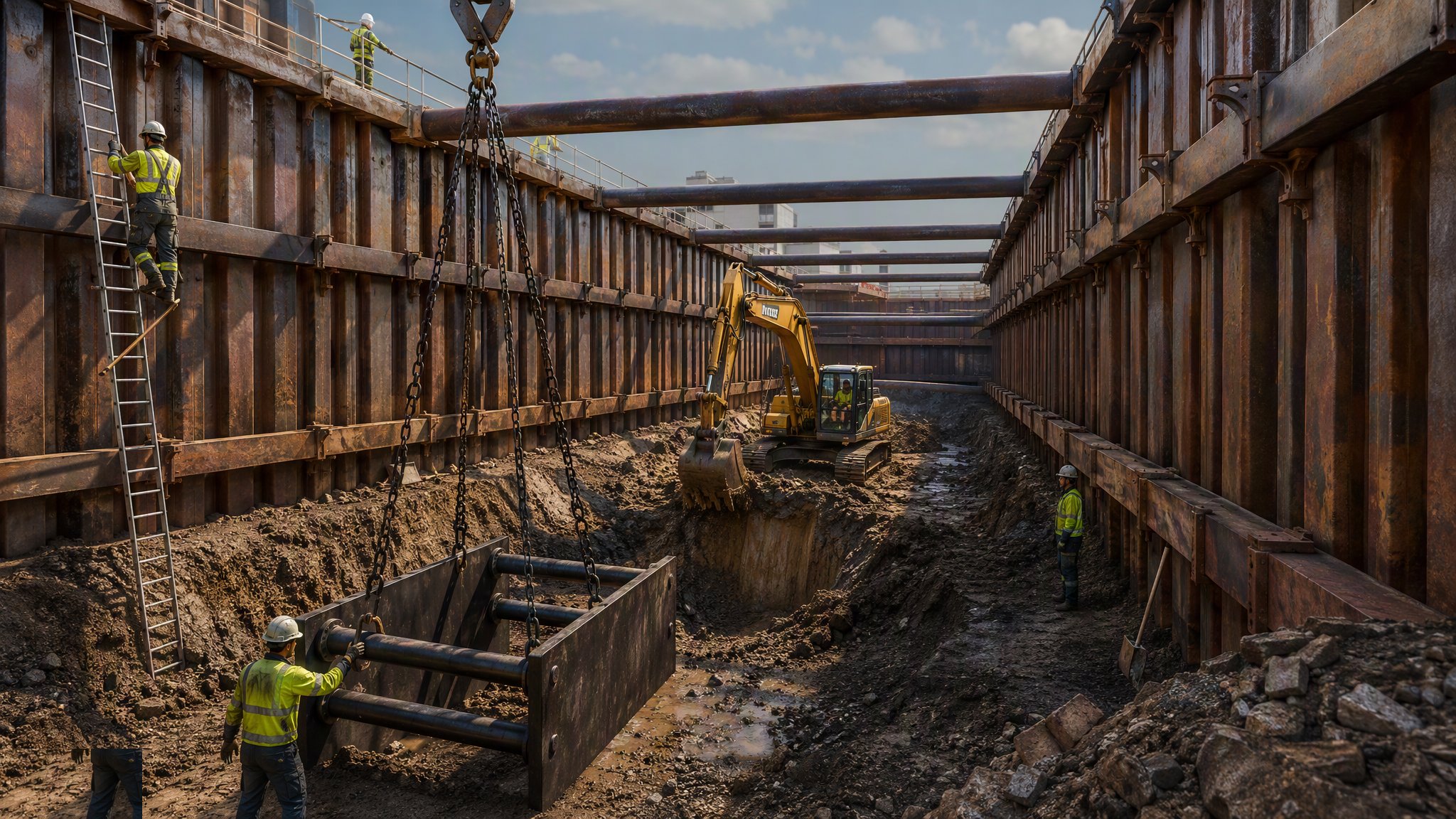
What is Cofferdams?
A cofferdam is a temporary enclosure built to keep water and ground out of a working area so that permanent structure can be built in the dry. The commonest form is a ring of interlocking steel sheet piles driven into the ground and braced internally with waling beams and struts as the dig goes down. Sheets are typically 6-20 m long, driven in a single length to around 20-25 m and spliced beyond that, and a single-skin braced dam is the usual answer down to something like 6-15 m of dig with a frame every few metres. Others are double-walled or cellular, filled with granular material so their own mass does the work, and small prefabricated box systems - generally good for 3-6 m - handle short-duration works such as an outfall or a manhole. Whatever the form, the principle is the same: create a barrier, take the water out from inside, build, then take the barrier away.
The choice of cofferdam is a balance between depth, water pressure, ground type and how much room there is. A single-skin braced dam is efficient but the bracing gets in the way of the structure being built inside it, so the frame layout has to be planned around the permanent works, not just around the loads. A double-wall or cellular dam needs far more space - as a rule of thumb its width is of the same order as the height it retains, which is why it belongs on open and marine sites rather than urban ones - but it leaves the inside clear, and the designer sets the actual geometry. In water, everything gets harder: piles are pitched from a pontoon or a temporary gantry, river levels and flow dictate the working window, which on a tidal site can be a few hours either side of low water, and scour around the outside of the dam can undermine the toe that the whole design depends on.
The dangerous part of a cofferdam is never the box - it is the water you cannot see. Pumping the inside down creates a pressure difference across the ground under the toe, and if the ground is granular that difference will try to push water and soil upwards into the excavation. It arrives as a soft, boiling base rather than a bang, and by the time it looks wrong the support to the pile toes has already gone. That is why the dewatering sequence is designed alongside the structure, why base sealing is a design decision rather than a reaction, and why the temporary works designer sets every level, load and stage in writing.
How does Cofferdams work, step by step?
- 1
Step 1: Design the box, the frames and the dewatering together
The temporary works designer works from the ground investigation, the water regime and the shape of the permanent structure. Pile section and penetration are set by the retained height and by what has to happen under the toe to control seepage. Frame levels are set by the loads but also by the concrete pours and reinforcement that have to pass through them, and by how the frames will eventually be removed. Frames typically land at 3-4 m vertical centres - close enough that the box is stiff, far enough apart that a cage and a pour will pass - but the spacing on any particular dam is the designer's. The dewatering scheme, the base treatment and the stage-by-stage sequence are part of the same design, not a separate exercise, and every level and load in it is theirs to set.
- 2
Step 2: Establish the platform, the guide frame and the exclusion
On land, a designed working platform is built for the piling rig and the service crane - typically 600 mm to 1.2 m of well-graded granular fill, sized for a machine that can weigh 60-100 tonnes with the hammer hung. In water, a pontoon, jack-up or piled gantry does the same job and brings marine risk assessment, navigation notices and rescue cover with it. A guide frame is set up at the plan position of the dam and surveyed in. It is what stops the piles wandering: a sheet pile that starts out of position or out of plumb pulls the next one with it, and the error compounds all the way round until the closure pile does not fit.
- 3
Step 3: Pitch and drive the sheets to closure
Sheets are pitched in the guide frame, usually in panels of four to eight rather than one at a time, then driven in stages so the whole ring goes down together and stays plumb. A crew in workable ground commonly pitches and drives 10-20 sheets a shift, so a modest dam is a week or two of driving rather than a day of it. Vibratory driving suits granular ground and is faster and quieter; impact driving is used where the ground is stiff or a firm toe is needed. Driving is monitored for declutching - a pile that has come out of its neighbour's interlock, usually on an obstruction - because a lost interlock is a slot straight through the wall that will run water and fines when the dam is pumped. Closing the ring is planned from the start, not improvised at the last pile.
- 4
Step 4: Dig and brace in strict sequence
Excavation goes down in lifts, commonly 1.5-3 m at a time, and each frame is installed and wedged home before the dig goes below it. This is the rule that gets broken. Digging one lift too deep to save a machine move overloads the frame above and the pile toes below, and the deflection that follows drags the ground behind the wall down with it. Frames are surveyed on installation and monitored for load and movement, and struts are protected from plant strikes. Access, lifting and rescue from a deep braced box are planned as part of the sequence, because a cofferdam is a confined, hard-to-escape working space.
- 5
Step 5: Control the water and seal the base
Water is taken out in stages that follow the dig, never in one go - commonly a metre or two at a time, with a pause to watch the base and the standpipes before the next stage - so the pressure difference across the base builds gradually and can be watched. Standpipes inside and outside track the water levels and give early warning that seepage is running. Where the ground would fail before the design depth is reached, the base is sealed - typically an underwater concrete plug placed before pumping out, or grouting to cut off the path - and its thickness is set by the designer against uplift rather than by what looks sufficient, because a sealed, pumped-out box is a boat. Discharge is settled and consented before a pump is switched on, and standby pumping capacity matches the duty capacity, because a dam that stops being pumped overnight is a dam that floods.
- 6
Step 6: Build inside, then dismantle in reverse
The permanent structure is built inside the box, with the frames coming out only as the structure takes over the job of holding the walls apart - a stage the designer sets and the site does not decide. Backfilling is placed and compacted in balanced lifts, commonly 150-300 mm at a time and taken up evenly on both sides so the dam is never loaded from one face only. Sheets are then extracted, and extraction is its own risk: it drags soil up with the pile, can settle ground and services behind the line, and near a finished structure it can be a movement problem in itself. Where extraction is too damaging, the designer may leave the sheets in place and cut them off below ground.
What are the benefits of Cofferdams?
- Creates a dry working area in ground and water conditions where open excavation is impossible
- Steel sheet piles are recoverable and re-usable, so the material cost is a hire cost rather than a write-off
- Well-understood, widely available and quick to install - a modest dam is commonly two to six weeks from platform to first dig, against months for in-situ concrete walling
- Suits water and marine work where there is no other practical way to reach the foundation level
- Vibratory driving is fast and comparatively quiet in the right ground
- The system can be adapted on site as conditions change, within the designer's parameters
What are the limitations of Cofferdams?
- Internal bracing gets in the way of the structure being built inside it, and the clash is often found too late
- Base failure by heave or piping in granular ground is the dominant hazard and can develop quickly
- Driving is defeated by obstructions, boulders and hard ground, and a declutched pile is a hole in the wall
- Vibration and noise from driving limits its use next to sensitive buildings and occupied premises, and the limits for those neighbours are set by assessment, not by the driving crew
- Dewatering draws the water table down outside as well as inside, which can settle neighbouring ground
- Extraction pulls ground up with the piles and can damage what has just been built or what lies behind the line
What is Cofferdams best suited for?
What plant does Cofferdams need?
- Piling rig or vibratory hammer suspended from a 50-100 t crawler crane, with an impact hammer where a firm toe is required, and excavator-mounted hammers for shallow work
- Sheet pile sections, guide frames, waling beams, struts and hydraulic props
- Crawler crane, and a pontoon, jack-up or piled gantry for over-water work
- Submersible and surface pumps, standby pumping capacity, settlement tanks and discharge monitoring
- Standpipes and piezometers inside and outside the dam, plus survey targets on the frames
- Confined-space and rescue equipment, gas monitoring and designed access and egress to the base
How is Cofferdams quality-checked?
- Temporary works design, sequence and permit to load issued and understood before any dig starts
- Pile driving records kept per pile, with declutching, refusal and out-of-position sheets reported not buried
- Frame installation and wedging confirmed at each level before excavation proceeds below it
- Water levels inside and outside logged daily and compared against the designer's triggers
- Base condition inspected during pumping down, with any softening, boiling or running water stopping the work
- Backfilling, frame removal and extraction carried out to the designer's written sequence and signed off in stages