AS/RS - cranes, miniloads and shuttle systems
Automated storage and retrieval - no drivers, extreme height and density, and a building often built around the machine.
Last updated 2026-09-06
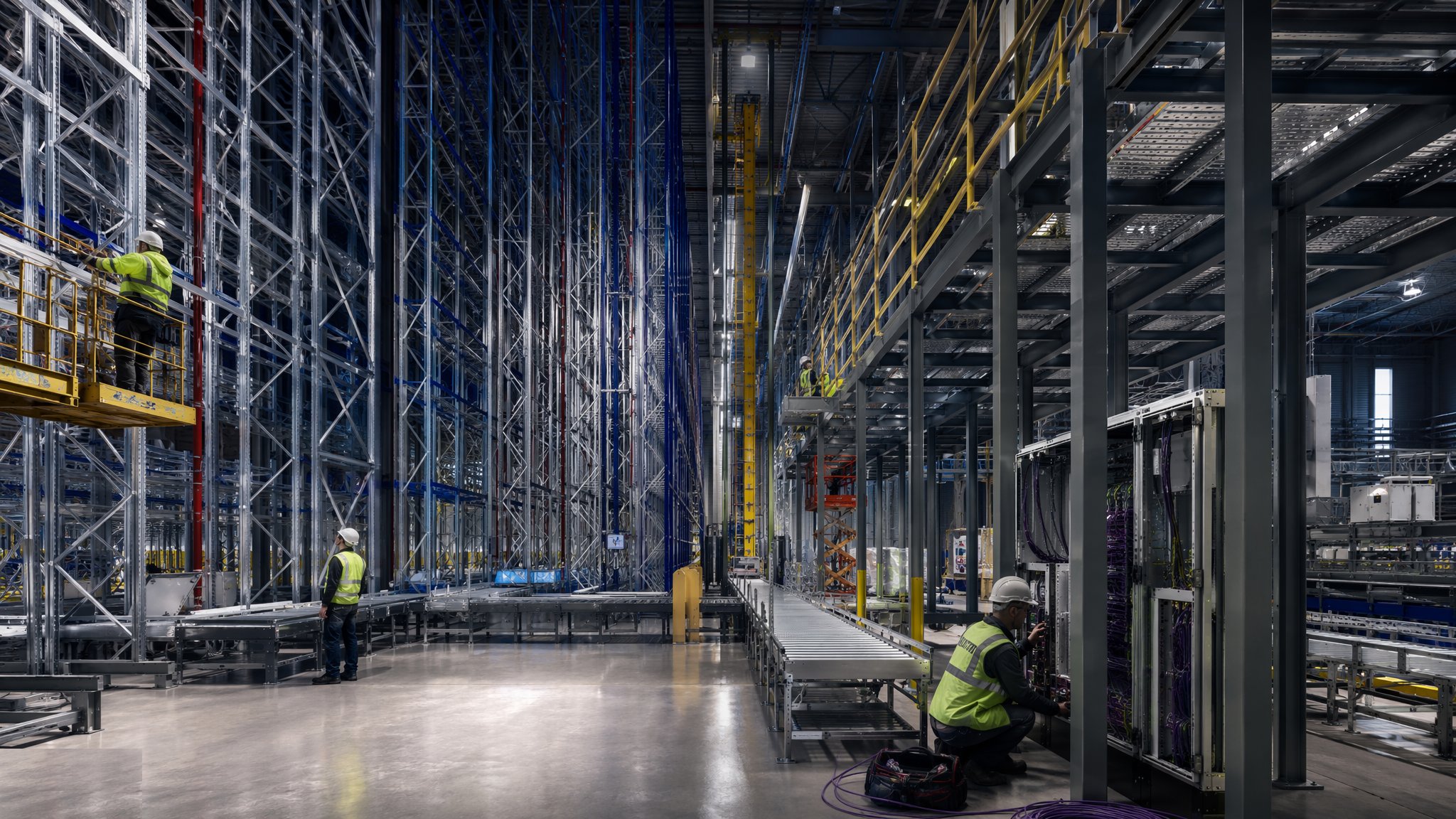
What is AS/RS - cranes, miniloads and shuttle systems?
An automated storage and retrieval system replaces the truck and its driver with a machine that runs on rails. A pallet crane travels the length of an aisle and lifts a mast to reach any position in the racking either side of it. A miniload does the same for totes, cartons and small items rather than pallets. A shuttle system distributes the work differently, with shuttles running on every level and lifts moving loads between levels. In all cases the aisle only needs to be wide enough for the machine, and there is no driver to see over the load, so the racking can be built far taller and far tighter than any manual system allows.
The consequence for the construction project is that the machine leads and the building follows. On most AS/RS projects the racking arrangement is fixed before the frame is designed, and in a clad-rack building the racking is the frame - the structure that holds the pallets also carries the roof and the walls. Even where the racking sits inside a conventional shed, the crane runway, the top guide, the floor tolerances and the height all come from the equipment supplier and constrain everything else. Late change is close to impossible. Anyone joining this kind of project after the frame is designed is joining a project whose main decisions have already been taken.
AS/RS buys throughput, density and consistency, and it buys them at a capital cost far above any manual system and after a commissioning period measured in months rather than weeks. Commissioning is the part that is routinely underestimated: the mechanical installation, the controls, the warehouse management interface, the exception handling and the recovery routines all have to be proved with real product before the operation can rely on the system. The racking remains a designed engineered structure with load notices, the automated aisles are a controlled area that people do not enter while the machines are live, and the inspection regime has to be planned around a structure that no one walks past every day.
How does AS/RS - cranes, miniloads and shuttle systems work, step by step?
- 1
Step 1: Define the throughput and the load before anything else
The equipment supplier sizes the system from the operator's throughput brief: how many movements in and out per hour, at peak and average, on what load carrier, and to what availability. That brief sets the number of aisles, the number of machines, the height and the length of the store. It cannot be revised later without revising the building, so it is challenged hard and signed off early.
- 2
Step 2: Decide clad-rack or racking inside a building
A clad-rack store uses the racking itself as the building structure, with cladding and roof fixed to it. It is efficient and it is committing, because the racking and the building become one thing that cannot be altered independently. The alternative is a conventional shed with the racking installed inside it, which costs more volume but keeps the two separable. The decision is taken jointly by the structural engineer, the racking designer and the equipment supplier, and it changes the planning, foundation and fire strategy work that follows.
- 3
Step 3: Design the foundations and floor to the machine's requirements
A tall automated store puts concentrated loads into the ground and demands tolerances that ordinary warehouse floors do not meet. The runway for each machine has to be laid within the tolerance the equipment supplier states, and the structural engineer designs the slab and foundations for the loads and settlements the system can accept. Those tolerances are surveyed and accepted before the machines are delivered, because correcting them afterwards means lifting equipment out again.
- 4
Step 4: Erect the racking structure to equipment tolerances
The racking is erected as a structure and checked as one, but to the tighter tolerances the machines require rather than to manual handling tolerances. Verticality over the full height, rail straightness, and the position of every load position relative to the machine datum all matter. The erection sequence, the temporary stability arrangements and the access provisions are planned by the installer because working at these heights inside a partly built structure is the main safety exposure of the whole project.
- 5
Step 5: Install the machines, rails and top guides
Bottom rails and top guides are installed and aligned, and the cranes, miniloads or shuttles are lifted in and assembled. This is heavy lifting inside a tall structure and it is planned as a lifting operation in its own right. Power supply, festoon or busbar, communications and safety circuits are installed alongside. Nothing moves under power until the mechanical installation is signed off.
- 6
Step 6: Install conveyors, transfer points and the interfaces
An AS/RS is only useful if loads reach it and leave it. Infeed and outfeed conveyors, transfer cars, profile and weight checks that reject a load the machine cannot handle, labelling and scanning points, and the interface with the manual part of the operation are all installed and aligned. The profile check at the infeed is worth its cost many times over, because a load that does not fit is the commonest cause of a stopped aisle.
- 7
Step 7: Commission in stages, then prove with real product
Commissioning runs from powered movement without load, through single-machine cycles, to full-rate running with the warehouse management system driving. Exception handling, recovery from a stopped machine, manual retrieval routines and the behaviour on power loss are all proved. Then the system runs with real product at real rates for an agreed period. On most projects this stage takes months, and the operational go-live date is set from it rather than from the mechanical completion date.
- 8
Step 8: Hand over with load notices, access control and a planned inspection route
Load notices are issued for the racking as for any other system. The automated aisles become a controlled area with interlocked access, and the isolation and entry procedure is trained and handed over rather than written and filed. Because nobody walks these aisles daily, the inspection regime has to be planned deliberately: a competent inspector examines the structure on the agreed cycle, any impact damage is assessed by a competent person before the aisle returns to use, and any change to the load carrier or the loading arrangement goes back to the racking designer and the equipment supplier together.
What are the benefits of AS/RS - cranes, miniloads and shuttle systems?
- Very high density and very high storage height, with aisles only as wide as the machine
- Consistent throughput that does not vary with shift, weather or labour availability
- Removes people from the storage aisles, and with them most impact damage
- Accurate stock control, because every movement is recorded by the system
- Works well in cold and conditioned stores, where keeping people out is an advantage in itself
- Clad-rack construction can deliver a store in less volume than a conventional shed plus racking
What are the limitations of AS/RS - cranes, miniloads and shuttle systems?
- Very high capital cost, justified only by sustained throughput over a long horizon
- A long commissioning period that is routinely underestimated in programmes
- The building is built to suit the machine, so the layout is effectively permanent
- Low flexibility - a change in load carrier or pallet profile can be a project in itself
- Failure of a machine takes a whole aisle out of use until recovery is complete
- Needs skilled maintenance and a spares strategy that a manual operation does not
What is AS/RS - cranes, miniloads and shuttle systems best suited for?
What plant does AS/RS - cranes, miniloads and shuttle systems need?
- Mobile and crawler cranes for lifting machines and structure into a tall building
- Mast climbers, scissor lifts and boom lifts rated for the heights involved
- Precision survey equipment for verticality, rail straightness and runway tolerance
- Alignment and levelling equipment supplied by the equipment supplier for rails and guides
- Power distribution, busbar or festoon installation equipment and controls test gear
- Temporary access, edge protection and rescue provision for work at height inside the structure
How is AS/RS - cranes, miniloads and shuttle systems quality-checked?
- Throughput brief and load carrier specification signed off before the building design is frozen
- Foundation and floor tolerances surveyed and accepted before machine delivery
- Racking verticality and rail straightness checked over the full height against equipment tolerances
- Mechanical installation signed off before any powered movement is permitted
- Staged commissioning record from no-load movement through to full-rate running with real product
- Load notices, access control procedures and a planned inspection route handed over together