Conveyors, sortation and goods-to-person
The moving fabric of a fulfilment operation - and a fit-out programme in its own right.
Last updated 2026-09-06
What is Conveyors, sortation and goods-to-person?
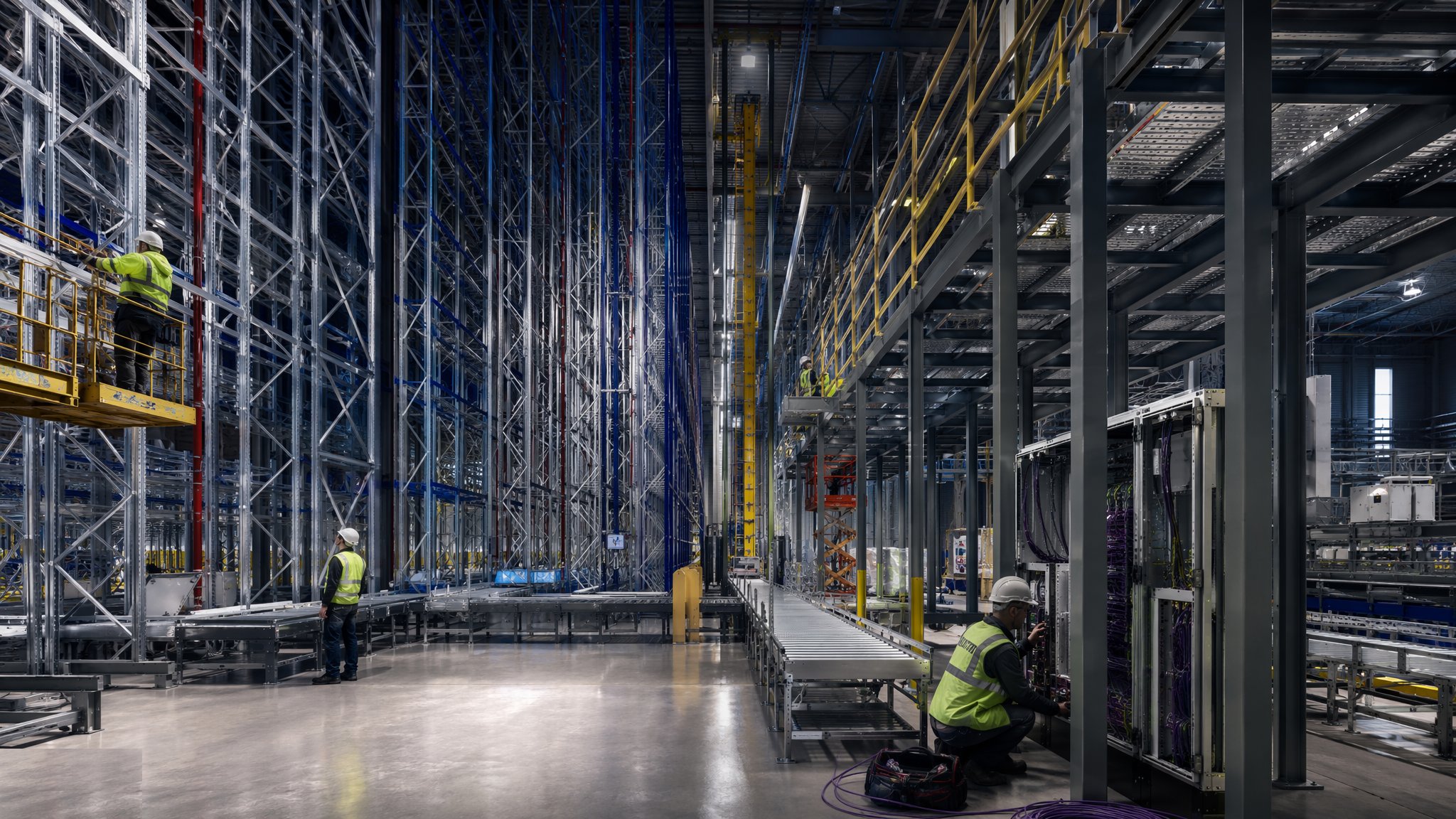
Conveyors, sortation and goods-to-person equipment are what turn a store of goods into a fulfilment operation. Conveyors move cartons and totes between areas. Sortation equipment reads a label and diverts each item to the right chute, lane or dock door. Goods-to-person stations reverse the traditional picking model - instead of a picker walking to the stock, the stock is delivered to a station where the picker stands still and works to a screen. Together they form a continuous system that runs the length and often the height of the building, and they are usually the busiest and most congested part of any warehouse project.
The defining characteristic for the construction team is that this is not equipment dropped into a finished building. It is an installation with structure, power, data, compressed air where used, controls, safety circuits and interfaces to almost everything else. It hangs from the roof, stands on the floor, passes through mezzanines and crosses walkways. It has to be coordinated with sprinklers, lighting, heating, smoke detection, fire compartmentation and escape routes, and that coordination is done in the model before anything is fabricated. Where a conveyor crosses a means of escape or passes through a compartment line, the fire engineer decides how, and that decision is designed in rather than resolved on site.
The other defining characteristic is programme. Installation is a long fit-out running after the building is watertight, and controls and software commissioning run longer still. A mechanically complete conveyor system that has not been commissioned moves nothing. Realistic programmes allow for staged handover of areas, for the operator's own testing with real product, and for a ramp-up period during which the system runs below design rate. Access, power and a clean, dry, secure building are the contractor's obligations to the installer, and late handover of any of them pushes the operational go-live date rather than the construction completion date.
How does Conveyors, sortation and goods-to-person work, step by step?
- 1
Step 1: Fix the process flow before the equipment
The operator and the equipment supplier map the flow first: how goods arrive, where they are decanted, where they are stored, how orders are picked, where they are consolidated, packed, labelled and despatched. The equipment follows the flow. Designing conveyors before the flow is agreed produces a system that works perfectly and does the wrong thing.
- 2
Step 2: Coordinate the system in the model with everything above and around it
Conveyor routes are modelled against the structure, the sprinklers, the lighting, the heating, the smoke detection, the compartment lines and the escape routes. Clashes are resolved in the model. Crossings over walkways get protection and headroom, penetrations through compartment lines get the treatment the fire engineer specifies, and access for maintenance is designed in rather than assumed. This stage is where a conveyor project is won or lost.
- 3
Step 3: Establish the building conditions the installer needs
The installer needs the building watertight, the floor finished, the power supplies available, the area clean and secure, and access for deliveries of long and awkward sections. Those conditions are agreed as dates and defended, because a conveyor installation cannot start in a building that is still being built around it. Storage space for delivered sections is planned, since the sections arrive faster than they can be installed.
- 4
Step 4: Install the supporting structure
Floor supports are set out and fixed, and roof hangers are installed to the structural engineer's design where the system is supported from above. Loads applied to the roof structure are checked and accepted before anything is hung from it. Where the system crosses or supports from a mezzanine, the interface is designed and detailed by the structural engineer rather than improvised by the installer.
- 5
Step 5: Install conveyor sections, sorters and stations
Sections are lifted into place, aligned and levelled, and joined progressively along each run. Sorters, mergers, diverts and spirals are installed at their designed positions. Goods-to-person stations are assembled with their screens, lighting and put-to-light or similar indication. Alignment matters more than it looks - a small step or twist at a joint becomes a jam under load, and jams at rate are what stop a fulfilment operation.
- 6
Step 6: Install power, data, controls and the safety circuits
Power distribution, motor control, sensors, scanners, network cabling and the control panels are installed and terminated. Emergency stops, pull cords, guarding, interlocked access gates and the safety circuits that stop the system when someone reaches in are installed and tested as a system rather than device by device. The safety functions are proved before the system is run at rate with people near it.
- 7
Step 7: Commission mechanically, then with the software, then with product
Commissioning runs in that order. Sections run empty. Sensors and scanners are proved. The control system is integrated with the warehouse management system and the sortation logic is tested with dummy loads. Then real product runs through at increasing rate, with the exception handling - misreads, jams, rejects, full chutes - deliberately provoked and proved. Recovery routines are rehearsed by the people who will use them.
- 8
Step 8: Hand over with training, spares and a maintenance regime
Handover is more than documents. The operator's team is trained on running, on clearing jams safely under the isolation procedure, and on the daily checks. Spares are agreed and stocked, the planned maintenance regime is set up, and the ramp-up period is agreed with a realistic expectation that the system will not reach design rate on day one. Any later change to the flow or the equipment goes back to the equipment supplier and the fire engineer as a design change.
What are the benefits of Conveyors, sortation and goods-to-person?
- Moves large volumes continuously with far less manual handling than a trolley-based operation
- Goods-to-person picking removes walking time, which is the largest single cost in manual picking
- Sortation gives accurate despatch to the right lane or dock without relying on operator judgement
- Scanning at every transfer point gives visibility and traceability across the whole flow
- Ergonomically better for pickers, who work at a station rather than reaching and walking
- Scales with volume - additional stations or lanes can often be added to a system designed for growth
What are the limitations of Conveyors, sortation and goods-to-person?
- A long installation and an even longer commissioning programme, both routinely underestimated
- Heavy coordination load with sprinklers, fire compartmentation, escape routes and services
- The layout becomes semi-permanent, and changing the flow later means changing the equipment
- A single failure can stop a whole flow, so redundancy and recovery have to be designed in
- Needs power, data and a clean, dry, secure building before installation can begin
- Maintenance, spares and trained people are an ongoing cost the operator has to carry
What is Conveyors, sortation and goods-to-person best suited for?
What plant does Conveyors, sortation and goods-to-person need?
- Scissor lifts and boom lifts for installation at height across a wide floor area
- Telehandlers and forklifts for offloading and moving long conveyor sections
- Lifting and rigging equipment for roof-hung supports and heavy sorter modules
- Laser levels and alignment equipment for setting runs true over long distances
- Electrical installation and test equipment, and controls commissioning gear
- Temporary storage and laydown provision for delivered sections
How is Conveyors, sortation and goods-to-person quality-checked?
- Process flow signed off by the operator before equipment design is released for fabrication
- Clash-free coordinated model agreed with the fire engineer and the services designers
- Roof and mezzanine support loads accepted by the structural engineer before anything is hung
- Alignment and level checked along every run and at every joint before load testing
- Safety circuits, emergency stops and interlocks tested as a system and recorded
- Staged commissioning record from empty running to full-rate running with real product, including exception handling