Very-narrow-aisle (VNA) racking
The same beam-and-upright structure, worked by a guided truck in an aisle barely wider than a pallet.
Last updated 2026-09-06
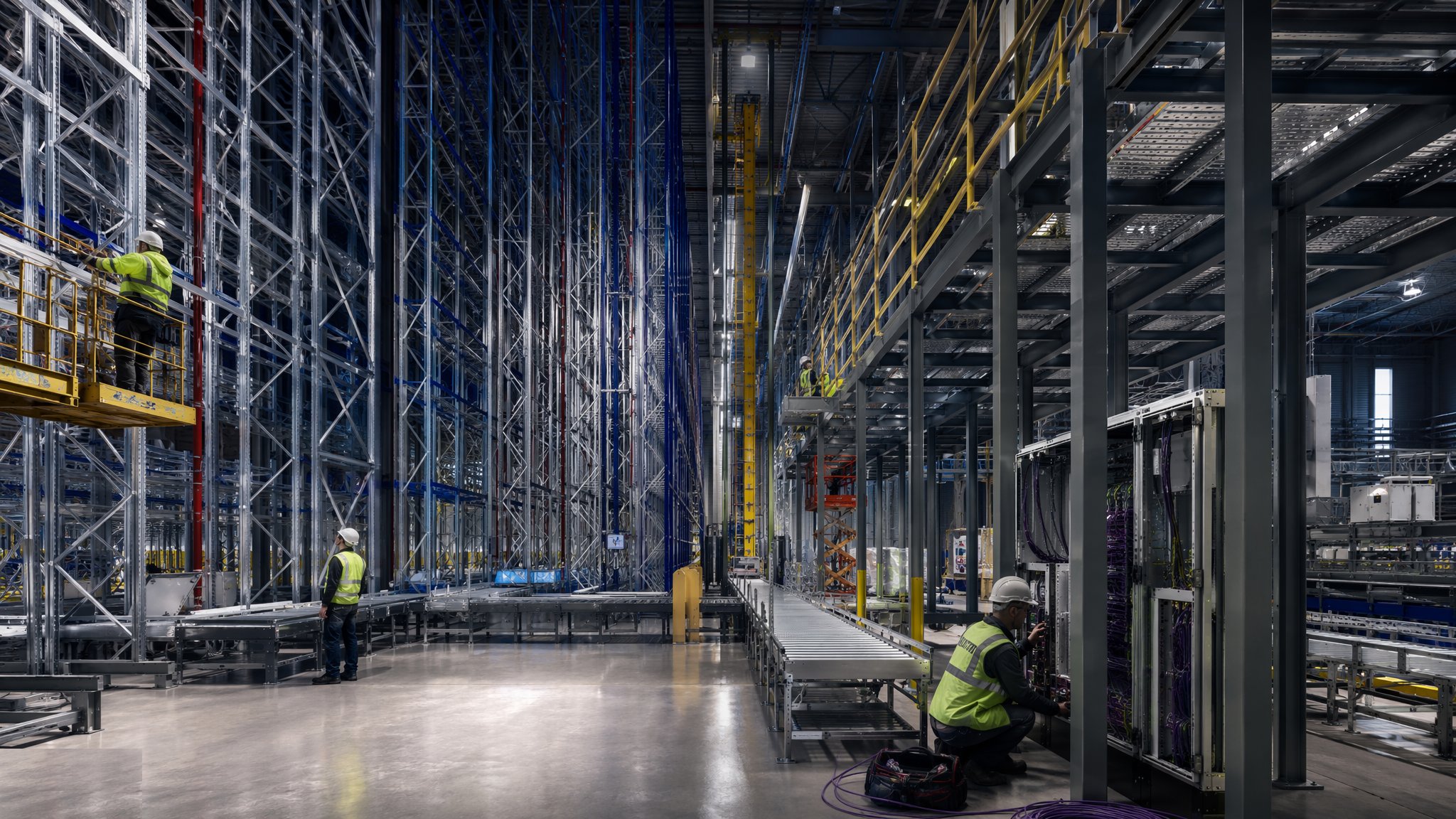
What is Very-narrow-aisle (VNA) racking?
Very-narrow-aisle racking uses much the same components as wide-aisle pallet racking. What changes is the aisle and the truck. Instead of turning to face the rack, a VNA truck runs down the aisle and lifts the load to one side or the other with a turret or a swinging fork, so the aisle only has to be wide enough for the truck and the load to pass. VNA aisles are commonly around 1.6-1.8 m wide as a general industry figure, against something well over twice that for a conventional reach truck aisle. The result is a large increase in the number of pallet positions that fit into the same building while keeping every pallet directly accessible.
The price of that density is precision. VNA trucks are guided down the aisle, usually by a wire buried in the slab or by rails fixed at floor level, because there is no room for the driver to correct a wandering line at speed. The floor has to be very flat, because the trucks operate at considerable height and small deviations at the wheels become large deviations at the fork. The floor flatness requirement is set by the truck supplier and the structural engineer together, it is written into the specification, and it is surveyed and accepted before the racking goes in. Retrofitting the required flatness into an existing slab is difficult and expensive, so on most projects VNA is decided before the floor is laid.
VNA also commits the operator. The trucks are specialist, they are expensive, they need trained operators, and they only work in the aisle they were designed for. If the fleet has to change, the aisle arrangement usually has to change with it. Against that, the system keeps full selectivity and unconstrained stock rotation while getting far closer to the density of a high-density store. On most projects the decision comes down to whether the extra pallet positions in an existing building are worth more than the flexibility being given up. The racking is still a designed engineered structure with a load notice, and the higher lift heights make impact damage assessment and the routine inspection regime more important rather than less.
How does Very-narrow-aisle (VNA) racking work, step by step?
- 1
Step 1: Decide VNA early, because the floor and the frame follow it
VNA is not a fit-out decision. The floor flatness, the slab construction, the guidance system, the sprinkler arrangement and often the building height all follow from it, so on most projects it is settled before the frame is designed. Retrofitting VNA into a building that was not planned for it usually means replacing or overlaying the floor, which is the most disruptive thing that can be done to an occupied warehouse.
- 2
Step 2: Select the truck fleet and the guidance method
The truck supplier is brought in with the racking designer. Man-up or man-down, turret or swing-fork, wire guidance or rail guidance, and the lift height required all interact. Wire guidance is cut into the slab and gives a clean aisle floor with no rail to hit; rail guidance is fixed to the floor at the aisle sides and is simpler to install and to alter, but the rails themselves take damage and take up space. The choice is the operator's, made on advice, and it is fixed before setting out because both methods are built into the floor.
- 3
Step 3: Specify, lay and survey the floor
The floor is the critical path item. The flatness and levelness requirements are stated in the specification by the structural engineer and the truck supplier, the slab is laid to achieve them, and it is surveyed along the defined truck paths rather than at random. The survey is accepted, or the floor is ground or replaced, before any racking is set out. Every VNA project that goes wrong on site goes wrong here.
- 4
Step 4: Install the guidance system
Wire is cut into the slab on the aisle centreline, bedded, and terminated at the aisle ends, or guide rails are set out and fixed to the floor. Either way the guidance line is the datum for the whole aisle, so it is set out from the survey grid and checked before the racking uprights are positioned against it. Aisle end arrangements, entry funnels and the interface with the cross aisles are installed at the same time.
- 5
Step 5: Erect the racking to tighter tolerances
The structure is erected as for wide-aisle racking - frames stood, plumbed, braced and fixed, beams engaged with their safety locks - but the permitted deviations are tighter, because a truck working at height in a narrow aisle has very little clearance to give away. Plumb and straightness are checked continuously rather than at the end, and the racking designer's tolerances govern. Runs are completed and released before any load goes on.
- 6
Step 6: Fit protection and aisle-end arrangements
End protection, aisle entry guides, floor markings, pedestrian barriers and the segregation between the VNA aisles and the rest of the operation are installed. Pedestrian access into a live VNA aisle is a controlled operation for the operator to manage, and the physical arrangements that support it are put in during installation rather than improvised afterwards.
- 7
Step 7: Commission the trucks against the installed racking
The truck supplier commissions the fleet in the actual aisles: guidance tracking, end-of-aisle slowdown, height selection where fitted, and any interface with the warehouse management system. Trial pallets are handled at the top beam level in each aisle before the operation is released. Faults found here are corrected against the racking as built, not against the drawing.
- 8
Step 8: Hand over with load notices and a tightened inspection regime
Load notices go up at the run ends as for any pallet racking. Because lift heights are greater and clearances are smaller, damage assessment matters more: any impact damage is assessed by a competent person, the affected area is offloaded until that assessment is complete, and the routine inspection by a competent inspector is set up as part of handover. Any change to beam levels or to the pallets being stored goes back to the racking designer as a design change.
What are the benefits of Very-narrow-aisle (VNA) racking?
- A large increase in pallet positions within the same footprint compared with wide-aisle racking
- Full selectivity is retained - every pallet is still directly accessible
- Stock rotation is unconstrained, so date-coded goods are handled as freely as in a wide-aisle store
- Uses building height effectively, which suits high-eaves modern units
- Guided trucks reduce the routine rack impacts caused by free steering in a narrow space
- Often the only way to get the required capacity out of an existing building without extending it
What are the limitations of Very-narrow-aisle (VNA) racking?
- Demands a very flat floor, specified by the engineer and surveyed before installation - this is the usual project risk
- Commits the operator to a specialist and expensive truck fleet with trained operators
- Guidance is built into the floor, so changing the aisle arrangement later is a major exercise
- Throughput per truck is lower than a wide-aisle reach truck, because the truck travels the length of the aisle
- Pedestrian access into a live aisle has to be managed as a controlled operation
- Working at greater height makes impact damage more consequential and inspection more important
What is Very-narrow-aisle (VNA) racking best suited for?
What plant does Very-narrow-aisle (VNA) racking need?
- VNA trucks supplied and commissioned by the truck supplier, man-up or man-down as selected
- Floor saw and wire installation equipment, or rail setting and fixing equipment
- Survey equipment capable of recording floor flatness along defined truck paths
- Scissor lifts and material handling plant sized to work within the narrow aisle
- Drilling and torque equipment for the specified slab fixings, with calibration in date
- Laser and total station setting out equipment referenced to the survey grid
How is Very-narrow-aisle (VNA) racking quality-checked?
- Floor flatness survey carried out along the defined truck paths and formally accepted before setting out
- Guidance wire or rail set out from the survey grid and checked before uprights are positioned
- Frame plumb and run straightness checked continuously against the racking designer's tighter tolerances
- Every beam safety lock present and engaged, checked run by run
- Truck commissioning trials completed at the top beam level in every aisle before release
- Load notices, installer's certificate and the inspection regime handed over as a package